

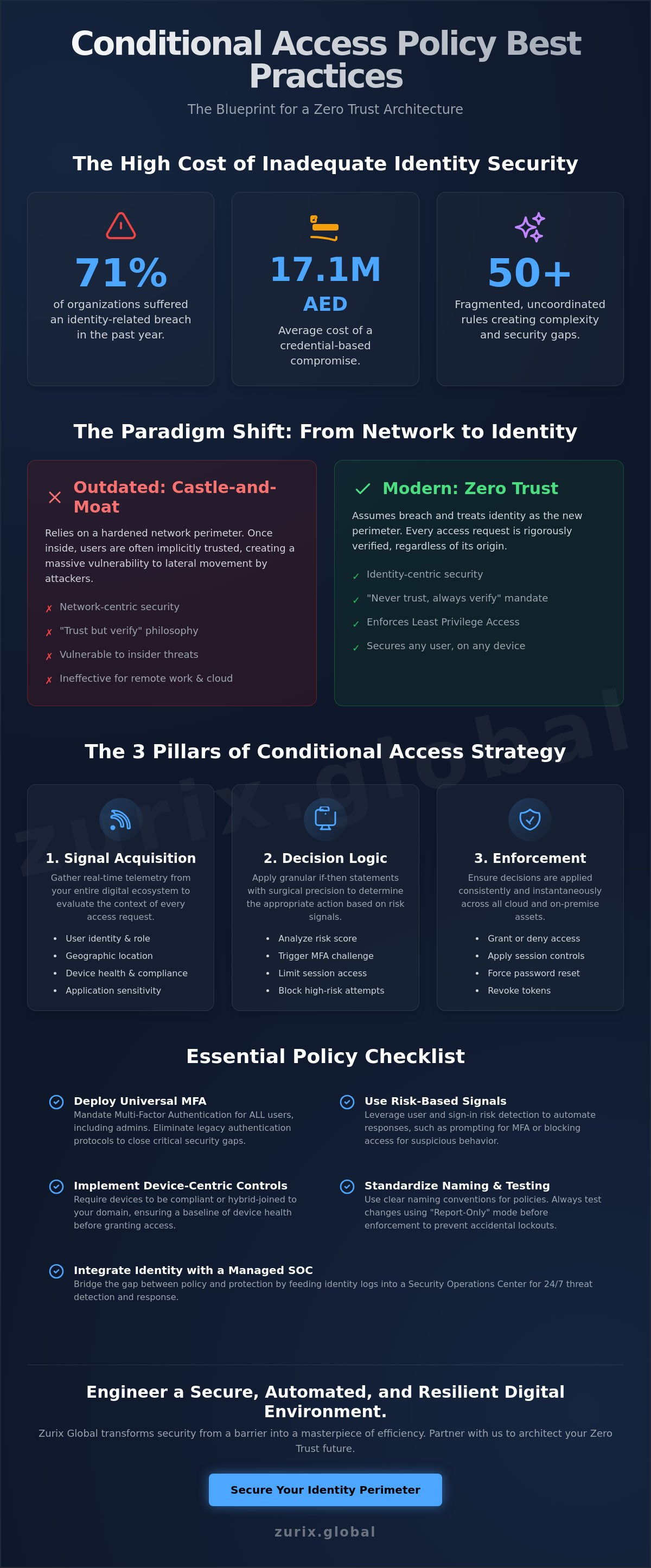
With 71% of organizations suffering identity-related breaches in the past year, the average cost of a credential-based compromise has surged to over 17.1 million AED. You likely feel the weight of managing a fragmented web of fifty uncoordinated rules, living with the constant shadow of a potential admin lockout and the frustration of users drowning in endless MFA prompts. It's a common struggle, yet it's one that a true technologist cannot accept. We believe that security shouldn't be a barrier. It should be a precision-engineered masterpiece of efficiency.
This article provides the definitive blueprint for conditional access policy best practices, allowing you to deploy a Zero Trust architecture that balances uncompromising defense with absolute user fluidity. You'll learn how to master the engineering precision required to streamline your policy sets and ensure strict alignment with UAE NESA standards. We'll guide you through reducing your identity-based attack surface while maintaining the seamless productivity your organization demands. The goal isn't just a secure network. It's the creation of a clean, automated, and resilient digital environment.
Key Takeaways
- Transform your security posture by shifting from outdated network-centric models to an identity-centric Zero Trust architecture where every access request is rigorously verified.
- Deploy conditional access policy best practices including mandatory MFA and the total elimination of legacy authentication to close critical security gaps.
- Master the use of risk-based signals and device-centric controls to automate responses to suspicious behavior while maintaining a frictionless user experience.
- Protect your infrastructure from accidental disruption through standardized naming conventions and the strategic application of "Report-Only" testing phases.
- Bridge the gap between policy and protection by integrating identity logs into a Managed SOC for real-time threat detection and response.
The Philosophy of Zero Trust: Why Conditional Access is Your Core Security Engine
The era of the castle-and-moat is dead. In today's hyper-connected landscape, the traditional network boundary has dissolved. Identity is the only remaining constant. Conditional Access stands as the intelligent gatekeeper, a sophisticated engine that evaluates every request with cold, mathematical precision before granting entry. It's the heartbeat of a modern Zero Trust architecture. At Zurix Global, we view this transition as a personal mission to transform security into a blend of high-performance engineering and technological art.
Transitioning from a network-centric to an identity-centric model requires more than a software update. It demands a total shift in mindset. We no longer assume safety based on a user's physical presence in a traditional office setting or their connection to a corporate VPN. Instead, we analyze the context of every interaction. Implementing conditional access policy best practices allows your organization to treat every login attempt as a unique event. You're no longer relying on a single locked door; you're deploying a multi-layered, automated defense system that adapts to threats as they emerge.
The Three Pillars of Conditional Access Strategy
Effective policy design rests on three fundamental engineering principles. These pillars ensure that your security posture remains both rigid against attackers and flexible for legitimate users. This structured approach prevents the common pitfall of creating a fragmented and unmanageable rule set.
- Signal Acquisition: This is the gathering of real-time telemetry from across your entire digital ecosystem. It includes the user's identity, their physical location, the health of their device, and the specific application they're trying to reach.
- Decision Logic: This is where the engine applies granular if-then statements with surgical precision. If a user logs in from an unfamiliar location on an unmanaged device, the logic might trigger a phishing-resistant MFA challenge or block access entirely.
- Enforcement: The final step ensures that these decisions apply consistently across all assets. Whether your data lives in the cloud or on-premise, the enforcement must be absolute and instantaneous.
Zero Trust vs. Traditional Access Control
The old mantra of "trust but verify" has become a dangerous relic. In 2026, trust is an exploited vulnerability. Modern enterprises must move toward explicit verification as their primary mandate. This alignment isn't just a recommendation. It's a necessity for meeting rigorous security standards. We don't give trust. We verify every signal, every time. There is no middle ground in high-performance defense.
At the center of this shift is the concept of Least Privilege Access. This means granting the minimum level of access required for a user to perform their specific role, and nothing more. It limits the blast radius of any potential compromise. By integrating these conditional access policy best practices into your identity lifecycle, you create a resilient environment. You're not just protecting data; you're architecting a masterpiece of modern security that stands firm against the most sophisticated adversaries.
The Essential Checklist: Core Conditional Access Policies for Every Organization
Precision is the hallmark of engineering excellence. To move from the Zero Trust vision toward a tangible state of security, an organization must implement a foundational set of rules that leave no room for ambiguity. These conditional access policy best practices serve as the structural steel of your security architecture. We don't settle for "good enough" configurations. We demand policies that are coolly precise and relentlessly effective. Every rule must serve a specific purpose in the defense of your digital estate.
The first mandate is universal Multi-Factor Authentication (MFA). The archaic practice of exempting "trusted" internal IP addresses is a critical vulnerability that modern adversaries exploit through lateral movement. Whether a user is connecting from a corporate headquarters in Abu Dhabi or a remote site, the requirement for MFA must be absolute. Coupled with this is the "Block Legacy Authentication" mandate. Older protocols like IMAP and POP3 don't support modern security challenges. Eliminating them immediately closes 99% of identity-based holes, as these protocols are the primary targets for password spray attacks.
Securing the "Keys to the Kingdom" requires even greater intensity. Administrative portals, such as the Azure Portal and Microsoft 365 Admin Center, must be guarded by heightened requirements. This includes shorter session lifetimes and a strictly enforced requirement for phishing-resistant credentials. Finally, geographic blocking should be implemented based on your specific organizational risk profile. If your business has no operational footprint in certain regions, there's no reason to permit traffic from those locations. It's a simple, effective way to reduce your visible attack surface.
Foundational Identity Protection
SMS-based MFA is no longer sufficient for high-value targets. It's brittle and susceptible to SIM-swapping. We prioritize phishing-resistant methods like FIDO2 keys or passkeys. Integrating Self-Service Password Reset (SSPR) within your CA boundaries ensures that even the recovery process remains under the Zero Trust umbrella. Aligning these controls with NIST's Zero Trust framework provides the architectural rigor needed to withstand the sophisticated threats of 2026.
Aligning with UAE Compliance Standards
For enterprises operating within the Emirates, alignment with NESA (National Electronic Security Authority) is mandatory. Your conditional access policy best practices must also respect the UAE PDPL (Personal Data Protection Law) by ensuring data residency signals are properly handled. Conditional Access supports NESA compliance by providing the explicit, real-time identity verification required to protect critical national infrastructure. If your current policy set feels like a collection of uncoordinated patches, our Zurix Global Microsoft 365 security and governance experts can help you architect a more resilient foundation.
Engineering Precision: Layering Risk-Based and Device-Centric Controls
True security is an art form of active intelligence. While foundational MFA is the bedrock, the true masterpiece of conditional access policy best practices lies in the dynamic layering of risk-based telemetry. We don't just look at who is logging in; we look at the health of the vessel they use and the probability of their intent being malicious. By utilizing Microsoft Entra ID Protection signals, we transform a static gate into a living, breathing defense mechanism that reacts with millisecond precision to the shifting sands of the threat landscape. It's about moving from a binary "yes or no" to a nuanced, context-aware decision engine.
To understand the granular details of these components, Microsoft's guide to building Conditional Access policies provides a comprehensive look at the underlying logic. However, the engineering challenge is applying this logic to the specific needs of a high-performance UAE enterprise. We distinguish between User Risk, which identifies compromised credentials found on the dark web, and Sign-in Risk, which detects suspicious patterns like impossible travel between Dubai and international hubs. This distinction is vital. It allows for an automated response that doesn't disrupt legitimate work. For a broader view of this ecosystem, explore our work in The Definitive Guide to Microsoft 365 Security.
The Device Compliance Mandate
Access should never be granted to a compromised endpoint. We enforce a strict mandate requiring devices to be either "Hybrid Azure AD Joined" or marked as "Compliant" by Microsoft Intune before they can touch corporate data. This ensures that every laptop or mobile device meets your specific encryption and patch-level standards. For personal devices (BYOD), we don't intrude on privacy. We use Mobile Application Management (MAM) as a fallback. This ensures that even if the hardware is unmanaged, the data within the application remains encrypted, protected, and under our absolute control.
Automated Response to Identity Threats
Efficiency is the enemy of SOC fatigue. By setting thresholds for "High Risk" users, we trigger mandatory, automated password changes that resolve threats without human intervention. "Medium Risk" signals might simply require a re-authentication with phishing-resistant MFA. This automated conditional remediation ensures your security team focuses on high-level strategy, not routine resets. It's about building a system that thinks for itself. We don't just build walls. We build an immune system for your digital identity.
Operational Excellence: Naming Conventions, Testing, and Emergency Protocols
Discipline is the invisible scaffolding of any architectural masterpiece. While the logic of a policy provides the defense, its operational management determines the resilience of the entire enterprise. Implementing conditional access policy best practices requires a commitment to order that transcends basic configuration. It's about ensuring that every rule is identifiable, every change is audited, and every emergency is anticipated with surgical precision. For the modern UAE enterprise, where digital continuity is a matter of national economic pride, there's no room for administrative chaos.
Standardized naming conventions are not a mere convenience; they are a requirement for professional governance. We reject the simplistic prefixes found in amateur guides. Instead, we advocate for a target-action-risk architecture. A policy named [CA-Global-MFA-AllUsers-HighRisk] tells a story. It defines the scope, the requirement, and the trigger at a single glance. This level of clarity is essential for internal auditing and meeting the rigorous GRC requirements common in the Dubai and Abu Dhabi financial sectors. Every rule must be a self-documenting component of your security vision.
Before any policy is enforced, it must exist in "Report-Only" mode. This isn't a suggestion; it's a mandate for operational safety. We use this phase to analyze telemetry and ensure that our security masterpiece doesn't inadvertently lock out a critical service account or disrupt a high-value transaction. Success is measured by the silence of the help desk upon deployment. To maintain this environment, true engineers prepare for the impossible. Every tenant must maintain "Break-Glass" accounts that are excluded from all CA policies. These are the emergency keys to the kingdom. They must be secured with long, complex passwords and stored in physical vaults, with their use monitored by real-time Azure Monitor alerts and Sentinel playbooks.
The Zurix Global Blueprint for Policy Naming
Clarity in naming is the first step toward a manageable security masterpiece. We use descriptions and tags to ensure that every policy aligns with specific NESA controls. This allows for rapid troubleshooting and seamless compliance reporting. When an auditor asks for proof of identity verification, your naming convention should provide the answer before they even open the policy settings. It's about demonstrating total control over the identity lifecycle.
Infrastructure as Code (IaC) for Conditional Access
We treat security as code. Managing policies through the Azure portal is a manual process prone to human error. By utilizing Terraform or the Microsoft Graph API, we bring version control and automated deployment pipelines to identity security. By codifying your conditional access policy best practices into version-controlled repositories, you eliminate the risk of accidental manual changes and prevent configuration drift. If you're ready to elevate your infrastructure, our DevOps & Automation Services provide the technical superiority required to automate these complex lifecycles. We don't just set rules. We engineer automated ecosystems that defend themselves.
The Zurix Advantage: Integrating Identity into a Managed Security Ecosystem
A masterfully designed gate is only as effective as the sentry who guards it. While implementing conditional access policy best practices provides the necessary structural defense, standalone policies remain static in a world of dynamic, AI-driven threats. True security excellence requires more than just a set of rules. It demands 24/7 vigilance. At Zurix Global, we believe that identity is the cornerstone of a broader, managed security ecosystem where every signal is not just recorded, but actively hunted. We don't just build walls; we architect living defense systems.
Integrating your Conditional Access logs with a Managed Security Operations Center (SOC) transforms passive data into actionable intelligence. When a "Medium Risk" signal triggers an MFA challenge, our analysts don't just see a log entry. They see a potential pattern of reconnaissance. This synergy between identity governance and proactive cybersecurity allows us to identify and neutralize adversaries before they can escalate their privileges. We don't just wait for an alert. We hunt for the subtle anomalies that indicate a breach in progress, ensuring that your identity perimeter remains impenetrable.
Proactive Threat Defense in the UAE
Zurix engineers resilient platforms by placing identity-first security at the heart of every deployment. Our approach ensures that your architecture remains compliant with local regulations while maintaining peak performance. We validate the effectiveness of your policies through annual GRC audits, ensuring that your conditional access policy best practices evolve alongside changing UAE security standards. For those seeking comprehensive protection, our Managed SOC Services in the UAE provide the high-performance defense required to protect critical assets around the clock.
Your Next Steps Toward Identity Maturity
The journey toward a Zero Trust masterpiece begins with a clear understanding of your current state. We recommend starting with a comprehensive identity security gap analysis to uncover hidden vulnerabilities in your existing tenant. From there, we build a roadmap that moves your organization from basic MFA to a fully automated, risk-aware environment. This isn't just a technical upgrade. It's a commitment to engineering perfection and a personal mission to secure your vision. If you're ready to transcend standard security and build a resilient digital future, partner with Zurix Global to engineer your digital masterpiece. We don't accept "good enough." We only accept the perfect.
Beyond Configuration: The Future of Identity Resilience
True security isn't found in a static list of rules. It lives in the relentless application of conditional access policy best practices that evolve alongside the threats they defeat. We've explored the transformation from outdated trust models to a precision-engineered Zero Trust architecture. You now understand that layering risk-based telemetry and maintaining operational discipline through standardized naming and automated testing are the hallmarks of a professional defense. These aren't just technical tasks; they're the foundational elements of a secure digital masterpiece that balances impenetrable protection with total user fluidity.
Managing this complexity at scale requires more than just internal focus. It demands a partner who understands the unique regulatory landscape of the United Arab Emirates. We combine advanced DevOps and Infrastructure as Code integration with deep expertise in NESA and PDPL compliance. Our 24/7 Managed SOC Monitoring ensures that your identity perimeter is never left unguarded. Don't settle for a fragmented security posture that creates friction and invites risk. Architect Your Zero Trust Environment with Zurix Global and experience the peace of mind that comes from uncompromising engineering excellence. Your vision deserves a fortress that's as ambitious as your goals.
Frequently Asked Questions
What is the most common mistake when setting up Conditional Access policies?
The most frequent error is failing to exclude emergency access accounts from restrictive policies. This leads to the administrative lockout nightmare. Without a dedicated "Break-Glass" account excluded from all rules, a single misconfigured policy can paralyze your entire tenant. We prioritize the creation of these accounts as the first step in any professional deployment to ensure permanent access.
How many Conditional Access policies should a medium-sized enterprise have?
While Microsoft allows up to 240 policies per tenant, a medium-sized enterprise should strive for a lean architecture of 10 to 20 well-defined rules. Complexity is the enemy of security. A smaller, coordinated set makes it easier to implement conditional access policy best practices without creating conflicting logic that frustrates users or leaves gaps for attackers.
Can I use Conditional Access to block access from specific countries?
You can absolutely use geofencing to block traffic from specific countries that fall outside your risk profile. By defining "Named Locations" based on IP ranges or GPS coordinates, you can restrict access to UAE-only or specific global regions where your team operates. This significantly reduces the visibility of your identity perimeter to international threat actors who target regional enterprises.
What is Report-Only mode and how long should I use it?
Report-Only mode is a sophisticated testing state that allows you to evaluate the impact of a policy without actually enforcing it on users. We recommend maintaining this state for at least two to four weeks. This duration provides enough telemetry to identify potential service account disruptions or unexpected user friction before the policy moves to full enforcement in your production environment.
How do I ensure I don’t lock myself out of the Azure Portal?
Preventing a lockout requires a disciplined approach to policy exclusions. You must always exclude at least two "Break-Glass" accounts from all policies and verify their access credentials regularly. Additionally, never move a policy from "Report-Only" to "On" without a thorough review of the Sign-in logs to confirm that your administrators still have a clear, uninterrupted path to the portal.
Does Conditional Access require a specific Microsoft 365 license?
Yes, Conditional Access requires specific licensing to function effectively. Basic policies demand Microsoft Entra ID P1 licenses for every user in scope. If you want to utilize advanced risk-based triggers, which we highly recommend for high-performance security, you'll need the Microsoft Entra ID P2 license level. Every user who benefits from these protections must be correctly licensed to remain compliant.
Can Conditional Access policies be applied to guest users and vendors?
Policies are highly effective when applied to guest users and external vendors. You can create specific rules for B2B identities to ensure they meet your MFA and device compliance standards before they touch corporate data. This ensures that your security masterpiece extends to every individual who interacts with your ecosystem, regardless of whether they are a full-time employee or an external partner.
How does Conditional Access integrate with a third-party SOC?
Integration is achieved by streaming Entra ID sign-in and audit logs to a centralized SIEM like Microsoft Sentinel or a third-party SOC platform via Diagnostic Settings. This allows for real-time threat hunting and the correlation of identity signals with other infrastructure events. It turns static policies into a proactive defense mechanism that alerts your security team to anomalies the moment they occur.