A masterpiece is not defined by its surface beauty but by the uncompromising integrity of its internal architecture. In a high-velocity environment where Software Supply Chain Failures now represent a critical threat in the 2025 OWASP Top 10, automating security in the ci/cd pipeline is the only way to ensure your digital creations remain resilient. You've likely felt the friction when security protocols become a bottleneck, or the exhaustion that sets in when teams are buried under false positives. It's a delicate challenge to balance rapid delivery with the rigorous demands of UAE-specific mandates like NESA compliance.
True engineering excellence demands that security empowers your creators rather than obstructing them. Speed must never compromise safety. This article promises to show you how to weave precision-engineered controls into your delivery flow, turning compliance into an automated byproduct of your build process. We'll explore how to leverage AI-driven analysis in SonarQube 2026.3 and architect a genuine shift-left culture. You're about to discover how to drastically reduce vulnerability remediation times while maintaining the relentless speed and performance your vision requires.
Key Takeaways
- Transition from fragile, reactive security models to a proactive DevSecOps architecture that treats security as a fundamental design element rather than an afterthought.
- Discover how to integrate SAST and DAST tools to analyze code DNA and simulate precision attacks during runtime, ensuring every deployment is a hardened masterpiece.
- Master the technical execution of automating security in the ci/cd pipeline through pre-commit hooks and seamless build-cycle integration to maintain maximum engineering velocity.
- Learn to map automated security checks to regional mandates like NESA and ISO 27001, transforming continuous compliance into a measurable competitive advantage.
- Understand why bespoke automation strategies outperform generic tools in complex cloud environments and how Zurix Global engineers uncompromising security into every layer.
The Architecture of Resilience: Why Automating Pipeline Security is Non-Negotiable
A digital masterpiece is never finished; it's continuously refined. In an era where the 2025 OWASP Top 10 highlights Software Supply Chain Failures as a top-tier risk, treating security as an afterthought is a dangerous gamble. We don't view security as a final inspection. Instead, we see it as the skeletal integrity of the entire build. Automating security in the ci/cd pipeline isn't just a technical upgrade. It's a commitment to engineering excellence that bridges the gap between a visionary digital strategy and the reality of every code commit.
From Reactive Checks to Proactive Engineering
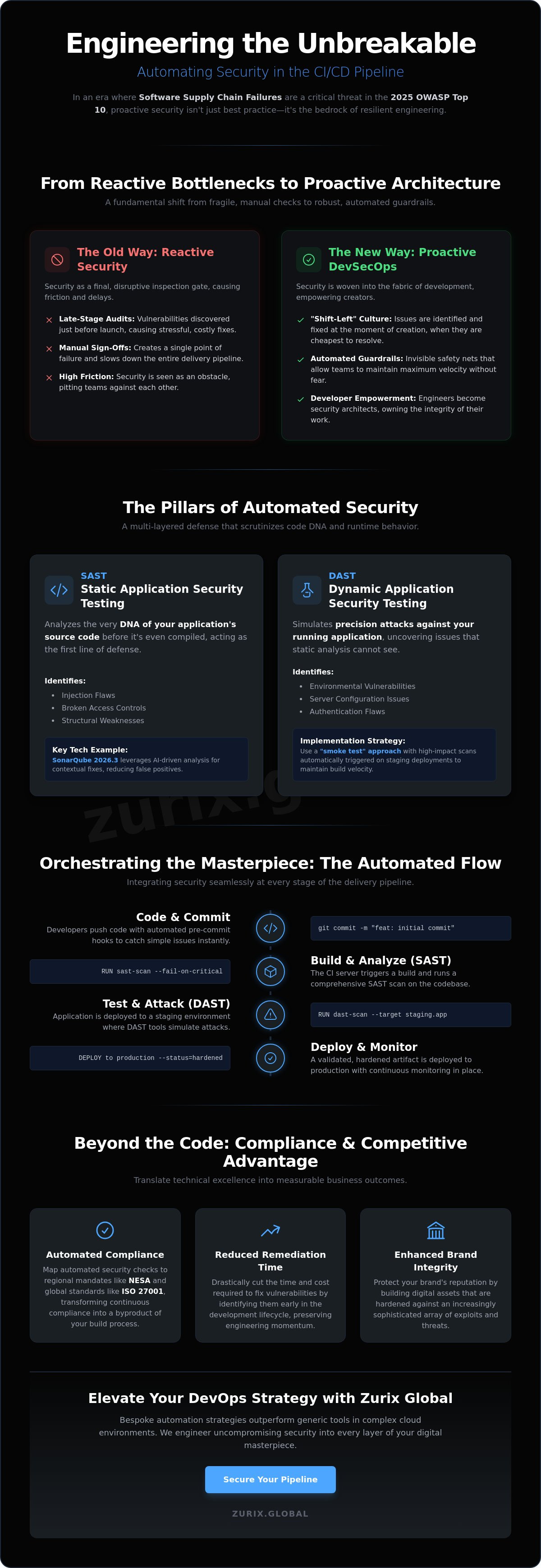
The "Shift-Left" philosophy has evolved from a buzzword into a survival requirement for UAE enterprises. In a market defined by rapid digital transformation, manual sign-offs represent a single point of failure that no modern organization can afford. We advocate for a psychological shift where developers are empowered as security architects. By integrating DevSecOps principles directly into the engineering workflow, we transform security from a reactive hurdle into a proactive engine of growth. This approach ensures that vulnerabilities are identified at the moment of creation, not weeks later during a stressful pre-launch audit.
The Cost of Friction: Balancing Speed and Integrity
Innovation thrives when engineers feel safe to move fast. When security remains a manual, siloed process, it inevitably creates friction that stalls momentum and increases time-to-market. In the 2026 threat landscape, delays aren't just inconvenient; they're costly. Automated guardrails provide the necessary structure to innovate without fear. These precision-engineered controls act as invisible safety nets, allowing teams to maintain velocity while ensuring every release meets the highest standards of integrity. This seamless integration is the hallmark of proactive cybersecurity strategies.
True resilience is built, not added. By automating security in the ci/cd pipeline, you replace fragile, human-dependent checks with robust, repeatable processes. This architectural choice protects your brand's reputation and ensures your digital assets are hardened against an increasingly sophisticated array of exploits. It's the difference between a temporary solution and a lasting masterpiece of engineering.
The Pillars of Automated Security: SAST, DAST, and Beyond
Engineering a resilient digital environment requires more than surface-level scanning. It demands a multi-layered defensive posture that scrutinizes every line of code and every runtime behavior. By automating security in the ci/cd pipeline, we establish a rigorous ecosystem where vulnerabilities are hunted with mathematical precision. We don't view these tools as isolated plugins; they are the foundational pillars that support the weight of your entire digital enterprise. When these systems work in concert, they transform your delivery pipeline into a self-healing engine of innovation.
Static Application Security Testing (SAST) acts as the first line of defense, analyzing the very DNA of your application before a single line is even compiled. It identifies structural weaknesses, such as the injection flaws and broken access controls highlighted in the 2025 OWASP Top 10. Modern tools like SonarQube 2026.3 now leverage AI-powered analysis to provide contextual fixes, reducing the burden on your engineering team. However, code that looks perfect in isolation can still fail under pressure. This is where Dynamic Application Security Testing (DAST) becomes essential. DAST simulates precision attacks against your running application, uncovering environmental vulnerabilities that static analysis simply cannot see.
Static and Dynamic Analysis: The Dual Sentinels
Precision is paramount when selecting SAST tools. You must choose engines that are deeply optimized for your specific language stack to minimize the noise of false positives. To maintain velocity, we recommend a "smoke test" approach for DAST integration, where high-impact scans are triggered automatically on every staging deployment without stalling the entire build. While SAST secures the internal logic of your creation, DAST validates its external resilience against real-world exploitation, together providing 360-degree visibility into your security posture.
Software Composition Analysis and Supply Chain Integrity
The 2025 OWASP Top 10 release candidate introduced "Software Supply Chain Failures" as a critical category, noting that while these incidents occur less frequently, they carry the highest average impact scores. Software Composition Analysis (SCA) is no longer optional. It's the process of generating a comprehensive Software Bill of Materials (SBOM) to track every third-party dependency. A single vulnerable library, if left unchecked, can compromise an entire cloud architecture, turning a trusted component into a backdoor for adversaries.
We also integrate automated secret scanning to prevent the "keys to the kingdom" from ever reaching your repository. Hardcoded API keys or database credentials are a primary target for automated scrapers. By automating security in the ci/cd pipeline, these leaks are intercepted at the pre-commit stage, ensuring your environment remains a fortress. If you're ready to move beyond generic checklists, our team can help you design a bespoke DevOps automation strategy that prioritizes both speed and uncompromising integrity.
Orchestrating the Masterpiece: A Step-by-Step Guide to Implementation
Orchestration is the difference between a collection of disjointed tools and a unified defensive shield. To achieve true resilience, the process of automating security in the ci/cd pipeline must be approached as a multi-layered engineering project. It begins where the creation starts: at the developer's fingertips. By treating security as a continuous thread woven through the development lifecycle, we eliminate the friction of traditional, end-of-cycle audits. This transition requires a disciplined, phased approach that hardens your digital assets at every stage of their evolution.
Phase 1 & 2: From Local Dev to Build Server
The most efficient way to secure a masterpiece is to prevent flaws from ever entering the source code. This starts with implementing linting and secret detection directly at the developer workstation through pre-commit hooks. When engineers receive immediate feedback within their IDE, they become the first line of defense. As the code moves to the build server, the CI environment must be configured to fail fast. High-severity vulnerabilities should trigger an immediate halt. To maintain velocity, rules must be tuned with surgical precision to minimize alert fatigue, ensuring that when the system speaks, the team listens. Every alert must be actionable and relevant to the specific risk profile of the project.
Phase 3: Infrastructure as Code (IaC) and Deployment Guardrails
Modern resilience extends beyond the application logic to the environment that hosts it. Security Misconfiguration has risen to the #2 spot in the 2025 OWASP Top 10, making IaC scanning a non-negotiable requirement for any serious enterprise. Whether you use Terraform or CloudFormation, your templates must be scanned for misconfigurations before a single resource is provisioned. We recommend implementing Open Policy Agent (OPA) to enforce fine-grained access control. It's critical that your Microsoft 365 security posture is mirrored in your automated deployment policies. This creates a unified governance framework that spans from your SaaS environment to your custom cloud workloads, ensuring no gaps remain in your defensive perimeter.
The final stage of orchestration is the establishment of continuous validation. Automating security in the ci/cd pipeline concludes with automated feedback loops that inform future development cycles. Every scan, every blocked build, and every remediated vulnerability provides data that refines the entire system. This is not a static process. It's a living, breathing architecture that adapts to the evolving 2026 threat landscape. By closing the loop between operations and development, you ensure that your digital assets remain as secure as they are innovative, turning security into a silent partner in your success.
Beyond the Code: Governance, Compliance, and Continuous Validation
Governance isn't a bureaucratic burden; it's the signature of a mature digital masterpiece. A common misconception persists that compliance requires manual checkpoints that inevitably kill velocity. We challenge this assumption. By automating security in the ci/cd pipeline, you transform static, paper-based requirements into a stream of real-time, immutable evidence. This transition isn't just about passing an audit. It's about demonstrating absolute control over your digital environment through architectural precision. When compliance is code, it becomes a silent guardian of your brand's reputation.
The 2026 regulatory environment, including the now-active SEC Regulation S-P amendments and the finalized CPPA regulations, demands a level of transparency that manual processes cannot match. Many organizations struggle because their governance moves slower than their deployment cycles. We solve this by embedding the requirements of the Governance, Risk, and Compliance (GRC) framework directly into the engineering workflow. This approach effectively addresses the objection that automation lacks the nuance of manual oversight. In reality, automated checks are more consistent, less prone to human error, and provide a comprehensive audit trail that manual reviews simply can't replicate.
Automating Compliance for UAE Regulatory Frameworks
UAE organizations face unique pressures from NESA and other local mandates that require rigorous information security standards. Manual evidence gathering is slow and often results in fragmented data. We utilize sophisticated pipeline tagging and logging to streamline ISO 27001 compliance in the UAE, creating a single source of truth for all security activities. Automation turns a stressful annual audit into a daily, effortless reality for your compliance officers. Stakeholders receive real-time, high-fidelity reports that reflect the actual state of security, ensuring that your organization remains resilient and fully aligned with national directives.
Runtime Security: Protecting the Living Ecosystem
A secure pipeline is only half of the masterpiece. The production environment must be equally resilient. We bridge the gap between development and operations by extending visibility into the runtime environment. Within complex Kubernetes clusters, we deploy eBPF-powered agents to detect behavioral anomalies that traditional security tools often miss. This data must not exist in a silo. Instead, it should be seamlessly integrated with managed SOC services in the UAE to provide a holistic, 24/7 defense. This synergy ensures that your digital assets are protected from the very first commit to the final execution in the cloud.
True engineering excellence means that your security posture is always visible and always validated. By automating security in the ci/cd pipeline, you build a foundation where innovation and integrity are inseparable. If you're ready to transform your compliance from a bottleneck into a competitive advantage, explore our GRC and automation consulting services to design a future-proof architecture.
Elevating Your DevOps Strategy with Zurix Global
Engineering a resilient digital masterpiece requires more than just a collection of licensed tools. It demands a vision that harmonizes speed with absolute integrity. While many providers offer generic, one-size-fits-all solutions, these often crumble under the weight of complex, high-stakes environments. At Zurix Global, we believe automating security in the ci/cd pipeline should be a bespoke endeavor. We don't just implement software; we architect a culture of engineering excellence where security is an inseparable part of the creative process. Our approach ensures that your delivery velocity remains unhindered while your defensive posture becomes impenetrable.
The true power of automation is realized only when it is guided by expert human intelligence. Our managed services provide the continuous oversight your automated systems need to navigate the sophisticated threats of 2026. We bridge the gap between technical execution and strategic governance, ensuring your infrastructure remains compliant and performant at all times. Choosing a partner is a statement of intent. It signifies that you refuse to settle for "good enough" and instead demand the perfect fusion of innovation and safety.
The Zurix Advantage: Precision, Performance, and Peace of Mind
Our expertise is deeply rooted in the unique landscape of UAE-specific compliance and digital transformation. We combine the efficiency of automating security in the ci/cd pipeline with rigorous, human-led expert analysis to eliminate the noise of false positives. By entrusting your environment to our specialists, you reduce the operational burden on your internal teams. This allows your creators to focus on what they do best: building the future. We provide the managed DevOps and automation framework that turns your technical debt into a strategic asset.
Begin Your Transformation
Your journey toward an uncompromisingly secure IT ecosystem starts with a single, strategic conversation. Our architects are ready to help you assess your current pipeline maturity and identify the critical paths for improvement. We'll work with you to design a custom roadmap that aligns your technical goals with your business vision. The path to a resilient digital future is complex, but you don't have to navigate it alone. Consult with our DevOps architects at Zurix Global today and start engineering your own digital masterpiece.
Mastering the Art of Continuous Resilience
Security isn't a final layer of paint. It's the structural integrity of your digital creation. We've explored how transitioning from reactive silos to proactive DevSecOps transforms your delivery pipeline into a self-healing engine. By integrating SAST and DAST with surgical precision, you ensure that every deployment remains a hardened masterpiece. Speed and safety aren't rivals; they're partners in a well-engineered system. Precision is non-negotiable. Your vision deserves an architecture that empowers innovation without exposing it to unnecessary risk.
Automating security in the ci/cd pipeline is the only way to maintain velocity while meeting the rigorous demands of UAE-specific mandates like NESA and ISO 27001. It turns the heavy burden of manual compliance into a seamless, automated reality. True excellence requires a partner who understands both the art and the science of technology. Our certified DevOps and cloud architects bring deep regional expertise and 24/7 Managed SOC integration to every project. It's time to stop compromising between innovation and safety. Architect Your Secure DevOps Future with Zurix Global and build a digital legacy that stands the test of time. Your journey to a resilient IT ecosystem starts here.
Frequently Asked Questions
What is the first step in automating security in a CI/CD pipeline?
The first step is establishing a "shift-left" cultural foundation where security is recognized as a shared engineering responsibility. You must define your organizational risk profile before selecting technical tools. This ensures that automating security in the ci/cd pipeline aligns with your specific business objectives. Starting with pre-commit hooks for secret detection offers an immediate, high-impact win for any development team.
How do I choose between SAST and DAST for my automation strategy?
You shouldn't choose between them because SAST and DAST serve different, complementary roles in a mature strategy. SAST analyzes the internal structure of your code during the build phase, while DAST tests the running application for environmental vulnerabilities. A resilient architecture requires both to provide 360-degree visibility. Using them together ensures that structural flaws and runtime exploits are both intercepted before they reach production.
Can I automate compliance for UAE-specific regulations like NESA?
Yes, you can automate compliance for UAE mandates like NESA and ISO 27001 by embedding control validation into your workflow. By using automated logging and real-time reporting, you transform compliance from a manual audit into a continuous byproduct of your pipeline. This approach provides immutable evidence of security controls. It allows your organization to meet local regulatory requirements without sacrificing the speed of your digital transformation.
How does automating security affect developer productivity?
Automating security actually enhances developer productivity by providing immediate feedback and reducing the need for costly, late-stage rework. When vulnerabilities are caught at the developer workstation, they're significantly easier and cheaper to fix. This proactive approach eliminates the "security bottleneck" that often stalls releases. It empowers your engineers to focus on creation rather than spending weeks patching flaws found during a final pre-launch audit.
What are the risks of over-automating security checks?
The primary risk of over-automation is "alert fatigue" caused by an excessive volume of false positives. If security tools are not tuned to your specific environment, they can generate noise that leads developers to ignore critical warnings. This undermines the entire defensive posture. It's essential to calibrate your automated guardrails to focus on high-severity risks, ensuring that every alert is actionable and relevant to your project.
Is it possible to secure a CI/CD pipeline for legacy applications?
It's entirely possible to secure legacy applications by wrapping them in modern containerized environments and applying automated scanning. Even if the underlying code is older, you can use Software Composition Analysis (SCA) to identify vulnerable dependencies and DAST to monitor runtime behavior. Automating security in the ci/cd pipeline for legacy systems provides a protective layer that extends the life and integrity of your existing digital assets.
How does Infrastructure as Code (IaC) scanning fit into the pipeline?
Infrastructure as Code (IaC) scanning fits into the build phase to prevent misconfigurations, which are now the #2 risk in the 2025 OWASP Top 10. By scanning Terraform or CloudFormation templates before resources are provisioned, you ensure your cloud environment is secure by design. This prevents "drift" and ensures that your infrastructure always adheres to your established security policies. It's a critical component of a Zero Trust architecture.
How often should automated security tools be updated or tuned?
Automated security tools require continuous tuning to remain effective against the evolving 2026 threat landscape. You should update your rule sets whenever new CVEs are published or when major industry standards, like the OWASP Top 10, are revised. Regular refinement minimizes false positives and ensures your tools can detect the latest exploitation techniques. This ongoing optimization is what separates a generic setup from a precision-engineered security masterpiece.