
A staggering 85% of UAE enterprises will transition their core operations to the cloud by 2026, but the difference between a technical failure and a digital masterpiece lies in the precision of the initial blueprint. You've likely felt the weight of this transition; the fear of a data breach during the migration of legacy systems is a valid concern when NESA compliance and ISO 27001 standards leave no room for error. A poorly executed cloud migration strategy doesn't just risk security, it creates a labyrinth of hidden costs that can drain your IT budget by 30% within the first year of operation.
We're here to ensure your transformation is an act of uncompromising engineering excellence. You'll master the complexities of modernizing your infrastructure with a checklist designed for the highest levels of security and performance. This article details how to leverage Infrastructure as Code (IaC) for automated reliability and build a scalable ecosystem that transforms your business into a high-performance work of art. We'll examine the exact steps to achieve full compliance while eliminating the architectural inefficiencies that plague unoptimized systems.
Key Takeaways
- Evolve beyond the limitations of "lift-and-shift" by treating security as the foundational element of your digital masterpiece rather than a post-migration afterthought.
- Master the 7 Rs framework to design a bespoke cloud migration strategy that optimizes every workload for the unique performance demands of the United Arab Emirates’ high-tech landscape.
- Implement a rigorous 10-step execution checklist that ensures uncompromising precision during infrastructure discovery and stakeholder alignment.
- Integrate Zero Trust principles and GRC audits into your initial planning to meet the stringent digital resilience standards required for 2026.
- Ensure perpetual excellence through post-migration governance and managed SOC services, turning your cloud infrastructure into a living engine of innovation.
Beyond the Lift-and-Shift: Defining a Visionary Cloud Migration Strategy
A cloud migration strategy isn't a mere technical checklist. It's a foundational blueprint for uncompromising digital resilience. In the UAE, where the digital economy is projected to contribute significantly to the non-oil GDP by 2026, businesses can't afford mediocre transitions. We view migration as a transition from restrictive legacy hardware to a digital masterpiece of cloud-native architecture. This process demands a fusion of engineering excellence and strategic foresight.
The "Lift-and-Shift" approach is a seductive trap. It promises speed but often delivers stagnation. Moving outdated, unoptimized workloads to the cloud without reconfiguration simply migrates your existing inefficiencies to a more expensive environment. It's like placing a vintage engine inside a modern hypercar chassis; the exterior looks advanced, but the performance remains capped. A true cloud migration strategy prioritizes refactoring and re-architecting to ensure your infrastructure scales with your vision.
The High Cost of Unplanned Migration
Cloud sprawl is the silent killer of enterprise budgets. Without a professional architectural foundation, UAE firms risk accumulating massive technical debt. Poorly configured instances lead to cloud computing challenges that compromise both security and fiscal health. Statistics indicate that mismanaged cloud resources can inflate operational costs by over 150,000 AED annually for mid-sized enterprises. In an era of sophisticated cyber threats, an unplanned move is a liability. A 2026-ready strategy treats security as a primary design element, not an afterthought. It's about precision. Every permission, every bucket, and every API must be engineered for total protection.
Cloud Architecture as a Competitive Advantage
Superior cloud architecture serves as the backbone of modern innovation. It's the difference between merely storing data and actively leveraging it. By moving beyond basic storage, you unlock the potential of AI-driven analytics, Kubernetes orchestration, and serverless computing. These aren't just buzzwords; they're the tools of market leaders. At Zurix, we believe that precision engineering meets technological art. We don't just build systems. We design high-performance environments that respond to market shifts in real-time. This level of agility is your greatest competitive edge in a fast-moving economy. We treat every cloud migration strategy as a personal mission to achieve perfection. When your infrastructure is a masterpiece, your business becomes unstoppable.
- Align technical goals with 2026 business scalability.
- Eliminate legacy bottlenecks through strategic refactoring.
- Ensure compliance with UAE data residency regulations.
- Optimize spend to maximize ROI in AED.
Success requires more than just a provider. It requires a partner who understands that "good enough" is the enemy of greatness. Your digital transformation deserves the precision of a master craftsman.
Architecting Security: The GRC and Zero Trust Pre-Migration Audit
Security isn't a layer you add at the end of a project. It's the first brick in your new digital ecosystem. In the UAE, where digital sovereignty and data residency are paramount, your cloud migration strategy must treat security as an engineering masterpiece. We don't just move workloads; we harden them. Before a single byte leaves your local servers, a comprehensive Vulnerability Assessment and Penetration Testing (VAPT) of the source environment is mandatory. This audit identifies existing fissures in your legacy architecture that could be exploited during the transition. It's a clinical, necessary step to ensure you aren't migrating yesterday's vulnerabilities into tomorrow's infrastructure.
Integrating Zero Trust Architecture (ZTA) into the initial plan shifts the paradigm from "trust but verify" to "never trust, always verify." This philosophy is mirrored in how federal agencies cloud migration protocols are established, emphasizing that readiness begins with a deep, uncompromising audit of current assets. By adopting these principles early, you eliminate the traditional "castle and moat" vulnerability. Every request, whether it originates from inside or outside the network, undergoes the same rigorous verification process.
Compliance by Design: ISO 27001 and Beyond
The UAE regulatory environment demands absolute precision. Aligning your cloud migration strategy with ISO 27001 compliance is a non-negotiable benchmark for 2026. We navigate the complexities of NESA (National Electronic Security Authority) and local data privacy laws with surgical focus. Mapping data flows ensures that cross-border movement doesn't trigger regulatory penalties, which can be severe. Each data packet must have a clear, documented path that maintains strict regulatory governance throughout the move.
Identity and Access Management (IAM) Strategy
The network perimeter is dead. Identity is the new firewall. We design a robust IAM framework centered on Multi-Factor Authentication (MFA) and least-privilege access before the migration begins. Every user role is defined with clinical accuracy to ensure that access is granted only to what is strictly necessary. Zero Trust eliminates the perimeter vulnerability in cloud-native setups, ensuring that even if a credential is compromised, the potential damage is contained. This level of control is the hallmark of a meticulously engineered digital ecosystem. It's about creating a system where performance and security exist in perfect, uncompromising harmony.
The 7 Rs Framework: Choosing Your Architectural Path
A cloud migration strategy isn't a simple relocation. It's a calculated act of engineering excellence. We view the 7 Rs framework as the palette from which we craft your digital masterpiece. Every workload demands a specific surgical approach. Rehosting offers speed but often lacks the depth of true optimization. Retiring eliminates dead weight. Replacing with SaaS provides utility. However, for enterprises seeking a competitive edge in the UAE market, where cloud spending is projected to reach AED 12.8 billion by 2026, the choice usually narrows down to more sophisticated paths.
The U.S. Department of Veterans Affairs Cloud Migration Framework illustrates how rigorous assessment prevents architectural debt. We apply a similar high-precision decision matrix to every workload. If an application's technical debt exceeds 40% of its total value, we don't settle for patches. We advocate for a total overhaul. Precision is our baseline. We demand more from your infrastructure than just "functional" status. At Zurix, our recommendation is clear: prioritize Kubernetes and containerization. This isn't just about efficiency; it's about building a foundation for modern scalability that remains uncompromising under pressure.
Replatforming for Performance
Replatforming allows us to modernize your hosting environment without disturbing the core application code. It's a "lift and reshape" approach. By moving to Platform as a Service (PaaS), you offload the burden of OS maintenance and licensing. We frequently transition clients to managed database services. This shift increases reliability by 99.99% while reducing administrative overhead. You gain the benefits of the cloud while keeping your existing business logic intact. It's an elegant solution for mission-critical systems that require immediate performance boosts without the risk of a full rewrite.
Rearchitecting: The Path to Cloud-Native Mastery
Rearchitecting is where engineering meets art. We decompose rigid monoliths into agile microservices. This is the only way to unlock the true ROI of the cloud. By integrating Infrastructure as Code (IaC) using tools like Terraform, we ensure your deployments are repeatable and error-free. Every component is designed for the cloud from the ground up. This approach allows for independent scaling of services, meaning you only pay for the power you actually use. In the fast-paced UAE tech landscape, this level of agility isn't a luxury. It's a requirement for survival. We don't just move your data; we transform your capability to innovate.
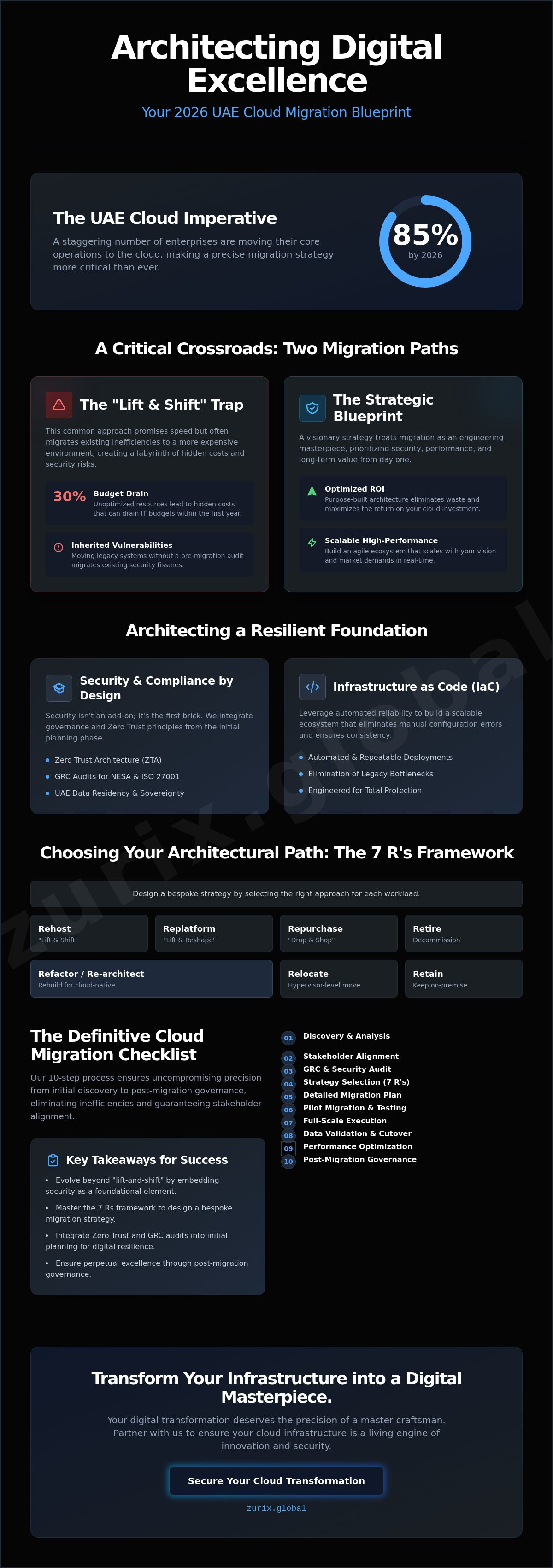
The Definitive Cloud Migration Checklist: 10 Steps to Execution
Execution represents the moment where architectural vision transforms into digital reality. A cloud migration strategy isn't a static document; it's a choreographed sequence of technical maneuvers designed to elevate your business operations. In the United Arab Emirates, where the "We the UAE 2031" vision demands rapid technological evolution, precision is the only acceptable standard. Follow this ten-step masterplan to ensure your transition is both flawless and secure.
- Step 1: Stakeholder Alignment and Vision Mapping. You must secure an absolute mandate from leadership. In the UAE market, 85% of successful digital initiatives are driven by a unified vision that links cloud adoption to specific Dirham-valued business outcomes.
- Step 2: Comprehensive Infrastructure Discovery and Dependency Mapping. We leave nothing to chance. Use automated tools to identify every application heartbeat and hidden dependency. 40% of migration delays occur because a single legacy connection was overlooked during the audit phase.
- Step 3: Security and GRC Gap Analysis. Your strategy must satisfy the rigorous standards of the Dubai Electronic Security Center (DESC) and NESA. Data residency isn't a suggestion; it's a sovereign requirement for UAE entities handling sensitive information.
- Step 4: Target Landing Zone Design. This is the "Masterpiece" blueprint where we build the environment's skeleton. A Landing Zone is the secure foundation for all cloud assets, engineered to provide a multi-account environment that scales with architectural precision.
- Step 5: Pilot Migration. We test the DevOps pipeline using a non-critical workload. 92% of enterprises that conduct a successful pilot report significantly fewer issues during the mass migration phase.
Execution and Automation Milestones
Step 6 involves Mass Migration Execution using automated Infrastructure as Code (IaC) scripts. We treat your infrastructure like a work of art, using Terraform or CloudFormation to ensure every resource is provisioned with surgical accuracy. Step 7 focuses on Data Integrity Validation and Synchronization. We utilize high-speed replication to ensure zero data loss. Step 8 implements Network Configuration and Zero Trust. Every identity is verified; no connection is inherently trusted. This creates a perimeter-less fortress for your data.
Final Cutover and Acceptance
Step 9 requires User Acceptance Testing (UAT) and Performance Benchmarking. We don't just move workloads; we optimize them. A 15% performance improvement over on-premises benchmarks is our minimum standard for success. Step 10 is the Final Cutover and Legacy Decommissioning. Once the new environment is validated, we sever the ties to the old world. This final act of decommissioning ensures you stop paying for redundant hardware and fully embrace the cloud's agility.
Continuous Excellence: Post-Migration Governance and Managed Resilience
The technical "Go-Live" date isn't a finish line; it's the dawn of a new era for your digital infrastructure. A cloud migration strategy that concludes once data settles into a new environment is a missed opportunity for true excellence. In the United Arab Emirates, where the digital economy is projected to contribute 20% to the non-oil GDP by 2031, your cloud presence must be a living, breathing masterpiece. Perfection requires constant refinement. We view post-migration as a perpetual journey of optimization where performance and security are never static.
Resilience in 2026 demands a 24/7 Managed Security Operations Center (SOC) that acts as the pulse of your ecosystem. It's not just about reacting to threats; it's about anticipating them. We implement continuous vulnerability management that scans for weaknesses in real-time, adapting to the shifting global threat landscape. This hűvösen precíz (coolly precise) approach ensures that your assets remain shielded within a fortress of code. Zurix Global maintains your environment as a technological work of art, ensuring that the initial vision of your digital transformation remains untarnished by inefficiency or risk.
DevOps and Automation Evolution
Engineering at the highest level requires removing human error through sophisticated CI/CD pipelines. These automated pathways allow for seamless, secure updates that keep your services at the cutting edge without a second of downtime. Automated scaling is equally vital. It manages costs by adjusting resources in real-time, ensuring you never pay for idle capacity while maintaining uncompromising performance during traffic spikes. We conduct a rigorous post-migration audit six months after the transition. This process verifies your ROI against original business drivers, ensuring every AED invested translates into measurable technical and financial superiority.
Your Partner in Digital Transformation
High-stakes migrations require more than just technical skill; they require a visionary partner who understands the weight of your ambitions. Zurix Global provides the elite expertise necessary to bridge the gap between complex engineering and bold business leadership. We don't just manage servers; we curate environments where innovation thrives. Our team treats every project as a personal mission, applying a level of precision that is rare in the industry. We understand the unique regulatory and performance requirements of the UAE market, providing a foundation for growth that is both stable and limitless. Elevate your infrastructure with a Zurix-led cloud migration strategy.
Architect Your Digital Legacy with Uncompromising Precision
Transitioning to the cloud isn't a mere change of scenery; it's a high-stakes engineering feat that demands a visionary cloud migration strategy. By 2026, Gartner projects that over 95% of new digital initiatives will be rooted in cloud-native platforms, making the move essential for any enterprise seeking market dominance in the UAE. Success hinges on moving beyond the "lift-and-shift" mentality to embrace a Zero Trust architecture and Kubernetes-driven agility. This isn't just about moving data. It's about crafting a secure, scalable masterpiece that serves as the backbone of your innovation.
Zurix Global delivers this level of technical mastery through expert-led delivery teams stationed in the UAE and Australia. Our specialists focus on the fusion of GRC compliance and high-performance engineering to ensure your transition is seamless. With our 24/7 Managed SOC, your post-migration environment remains resilient against evolving threats, providing the peace of mind that only true precision can offer. We treat every project as a personal mission to achieve technological perfection. You deserve a partner who views your infrastructure as a work of art.
Begin your secure transformation with Zurix Global and let's build your future with the dedication it deserves.
Frequently Asked Questions
What are the 7 Rs of cloud migration strategy?
The 7 Rs of cloud migration strategy consist of Rehost, Replatform, Refactor, Rearchitect, Retire, Retain, and Relocate. These frameworks serve as the architectural pillars for moving digital assets with surgical precision. We view these options as distinct engineering paths that determine the final performance and efficiency of your technological masterpiece.
How long does a typical enterprise cloud migration take?
A typical enterprise cloud migration in the United Arab Emirates takes between 12 and 24 months to execute with total precision. This duration accounts for the rigorous discovery phase, pilot testing, and the final cutover of complex legacy systems. Large-scale projects involving more than 450 virtual machines often require a 30 month window to ensure uncompromising performance throughout the transition.
What is the most secure cloud migration strategy for highly regulated industries?
The Rearchitecting approach combined with a Hybrid Cloud model stands as the most secure cloud migration strategy for regulated sectors in Abu Dhabi and Dubai. This configuration allows organizations to meet UAE DESC and NESA compliance standards by keeping sensitive data within local borders while utilizing cloud scalability. It's a fortress-like design that prioritizes data sovereignty and absolute technical integrity.
How much does cloud migration cost in 2026?
Cloud migration costs in 2026 range from AED 220,000 for localized SME setups to over AED 4,000,000 for complex UAE enterprise infrastructures. These figures represent the investment required for high-performance hardware integration and advanced cybersecurity layers. Every dirham spent is an investment in engineering excellence and the elimination of future technical debt.
Can I migrate to the cloud without disrupting my current business operations?
You can migrate to the cloud without disruption by implementing blue-green deployment strategies and a phased transition model. This methodology targets a 99.99% uptime threshold, ensuring your business operations remain fluid and responsive during the shift. It's a seamless evolution where your digital infrastructure continues to perform at its peak while we orchestrate the underlying change.
What is the difference between cloud migration and cloud modernization?
Cloud migration is the process of moving existing workloads to a cloud environment, whereas cloud modernization involves re-engineering those workloads to be cloud-native. Migration is the relocation of your digital foundation; modernization is the refinement of that foundation into a high-performance tool. Modernization typically results in a 25% increase in application responsiveness compared to basic migration methods.
How does Zero Trust Architecture fit into a cloud migration plan?
Zero Trust Architecture fits into the plan by enforcing strict identity verification for every access request, regardless of where it originates. In the UAE market, where 52% of organizations have now adopted identity-centric security, Zero Trust acts as the primary defense layer for your digital estate. It's a non-negotiable standard for any project that treats security as a fundamental element of technological art.
What are the biggest risks of cloud migration?
The biggest risks include data breaches during transit, unforeseen cost escalations, and vendor lock-in that limits future flexibility. Statistical evidence shows that 38% of cloud projects fail to meet their initial goals because of inadequate architectural planning. We eliminate these risks through meticulous engineering and a commitment to perfection that leaves no room for error.