
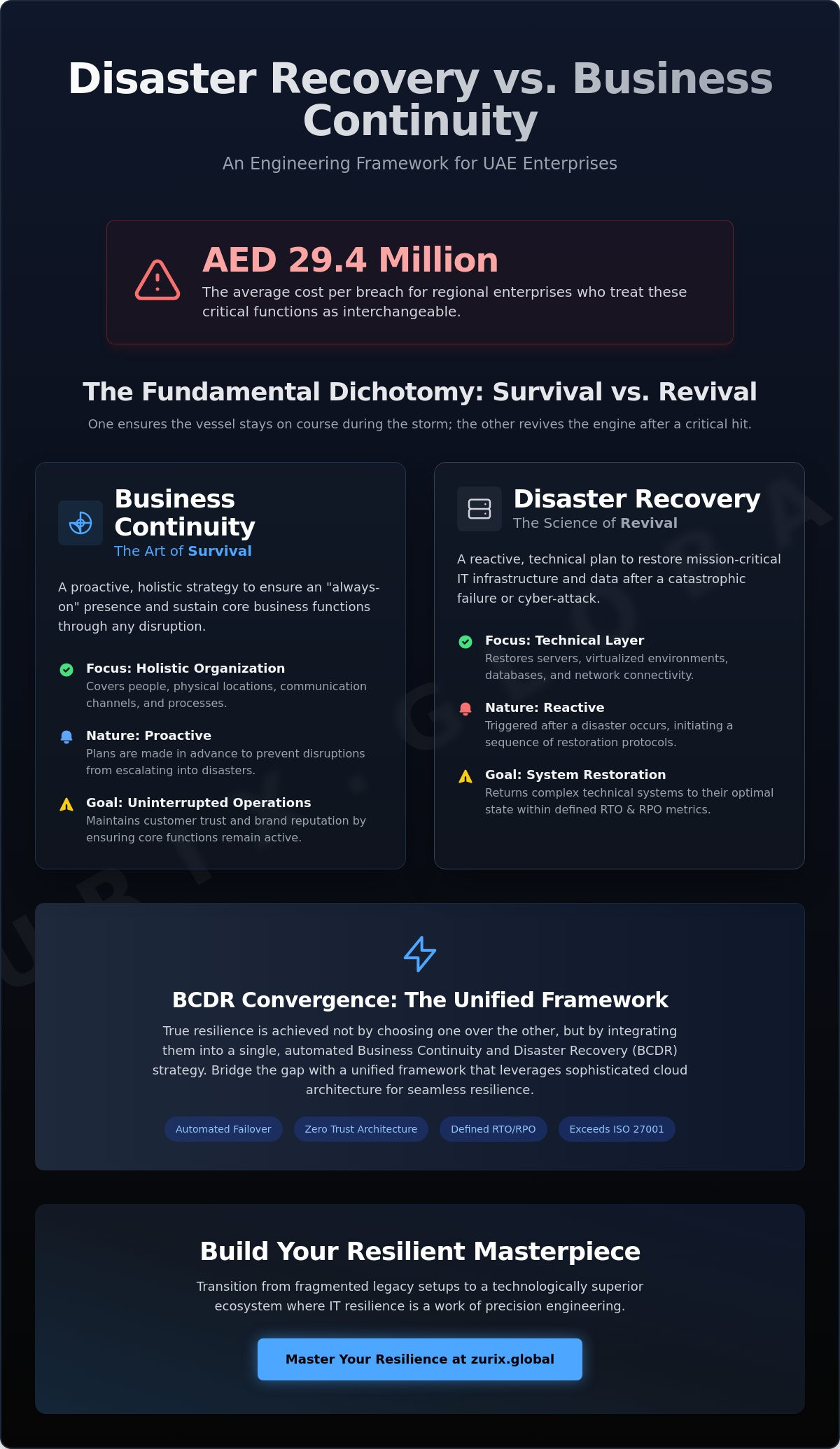
In the high-stakes digital landscape of Dubai and Abu Dhabi, treating disaster recovery vs business continuity as interchangeable terms is a structural flaw that costs regional enterprises an average of AED 29.4 million per breach. You understand that your infrastructure must be more than just functional. It needs to be an unbreakable masterpiece of engineering that survives the most aggressive cyber threats. We treat every system as a mission-critical challenge where "good enough" is a failure of vision. Precision is our only standard.
You've likely felt the pressure of meeting the UAE's strict GRC requirements while vendor jargon clouds the path to true security. We'll help you master the technical nuances between these two pillars to transform your IT environment into a resilient ecosystem that exceeds ISO 27001 standards. This guide provides a clear framework for BCDR integration and demonstrates how to automate resilience. You'll learn to ensure your operations remain flawless and your data remains untouchable through uncompromising technical excellence.
Key Takeaways
- Differentiate between targeted IT infrastructure restoration and the holistic organizational strategies necessary to sustain core business functions during any disruption.
- Define and implement uncompromising RTO and RPO metrics through automated failover systems designed for the high-stakes UAE enterprise market.
- Integrate Zero Trust Architecture into your operational DNA to neutralize threats and prevent disasters before they can impact your bottom line.
- Bridge the gap between disaster recovery vs business continuity using a unified BCDR framework that leverages sophisticated cloud architecture for seamless resilience.
- Transition from fragmented legacy setups to a technologically superior ecosystem where IT resilience is treated as a masterpiece of precision engineering.
The Fundamental Dichotomy: Defining Disaster Recovery and Business Continuity
In the high-stakes corporate environment of the United Arab Emirates, where digital transformation drives a massive portion of the non-oil economy, the distinction between operational resilience and technical restoration is a matter of corporate survival. Understanding the nuances of disaster recovery vs business continuity is the first step toward architecting a truly resilient enterprise. While these terms are often conflated in casual conversation, they represent two distinct pillars of enterprise architecture. One acts as the emergency response team that revives a stalled engine; the other ensures the entire vessel remains on course regardless of the storm.
The "Survival vs. Revival" paradigm defines this relationship perfectly. Business Continuity is the art of survival, ensuring that core functions remain active during a crisis. Disaster Recovery is the science of revival, focused on returning complex technical systems to their optimal state. For organizations navigating the UAE's stringent regulatory framework, including NESA (National Electronic Security Authority) standards, this distinction is critical for Governance, Risk, and Compliance (GRC) audits. Auditors demand clear evidence that a firm can maintain operations while simultaneously executing technical recovery. Failing to separate these functions can lead to compliance gaps that jeopardize licenses and result in substantial financial penalties in AED.
Disaster Recovery: The IT Engine of Restoration
Disaster Recovery (DR) focuses on the technical layer of the enterprise. It encompasses the restoration of mission-critical assets, including:
- High-performance servers and virtualized environments
- Relational and non-relational databases
- Intricate network connectivity and security gateways
The nature of DR is inherently reactive. It's the sequence of events triggered the moment a "red button" is pushed following a system failure or cyber-attack. At Zurix, we view these systems as technological masterpieces that require precise restoration protocols to maintain their integrity. Disaster Recovery is the tactical execution of IT system revival.
Business Continuity: The Strategic Umbrella
Business Continuity (BC) is the proactive, holistic strategy designed to ensure an "always-on" presence. It covers people, physical locations, and communication channels. Comprehensive Business continuity planning ensures that even if a primary headquarters in Abu Dhabi or Dubai becomes inaccessible, the brand's reputation remains untarnished. It's about maintaining customer trust through uncompromising reliability. While DR restores the hardware, BC manages the human and process-driven elements that keep the business viable. This strategic umbrella protects the organization's long-term vision, ensuring that a temporary disruption doesn't become a permanent failure.
Disaster Recovery in the Age of Automation and DevOps
Traditional backup methods have become a relic of a slower, less demanding era. In today's high-stakes environment, resilience is an engineering masterpiece, not a background task. We've moved beyond simple data duplication into the realm of automated failover systems that mirror the complexity of the original architecture. While the broader strategy of disaster recovery vs business continuity often overlaps, disaster recovery is the surgical, technical precision required to resurrect your digital infrastructure from the ashes of a catastrophic event.
Modern recovery relies on Infrastructure as Code (IaC). This approach treats your entire server environment as software, allowing us to rebuild complex networks in the UAE cloud or on-premise hardware with absolute consistency. A Managed SOC (Security Operations Center) acts as the nervous system for this process. It monitors for anomalies and identifies the exact moment a breach or failure necessitates a DR trigger. By integrating these systems, we eliminate the human hesitation that often costs UAE enterprises millions of Dirhams in lost productivity.
Setting the Benchmarks: RTO and RPO
Every second of downtime in a Dubai-based financial hub or an Abu Dhabi logistics firm carries a specific price tag. To master recovery, you must define two non-negotiable metrics. Recovery Time Objective (RTO) dictates the maximum tolerable duration of a service outage. For mission-critical applications, this is often measured in minutes. Recovery Point Objective (RPO) determines the age of the files that must be recovered from backup storage for normal operations to resume. If your transaction volume is high, an RPO of even one hour could result in the loss of thousands of critical entries.
Aligning these metrics with ISO 27001 compliance ensures that your technical recovery isn't just fast; it's legally and ethically sound within the UAE's regulatory framework. Citing Ready.gov business continuity guidelines provides a foundational perspective on how these technical benchmarks support the wider organizational survival plan. It's about creating a blueprint for survival that withstands any pressure.
Automated Recovery: The DevOps Advantage
The fusion of DevOps and disaster recovery has birthed self-healing infrastructures. Using Kubernetes and containerization, systems can now detect their own failures and spin up new instances without manual intervention. This level of automation transforms the disaster recovery vs business continuity dynamic by making the technical recovery almost instantaneous, allowing the business to focus on human and operational management. We typically deploy two primary models in the cloud:
- Pilot Light: A cost-effective approach where minimal versions of your critical services are always running, ready to scale up instantly during a crisis.
- Warm Standby: A scaled-down but fully functional version of your environment that remains in sync with your primary site, ensuring near-zero RPO.
A disaster recovery plan that isn't rehearsed through automated testing is merely a liability. Continuous testing ensures that when the "big red button" is pushed, the code executes perfectly. For those who demand this level of uncompromising performance in their infrastructure, automation is the only path forward. It's the difference between a panicked response and a calculated, professional execution of a recovery masterpiece.
Business Continuity: Creating a Resilient Enterprise Culture
True resilience isn't found in a server rack. It's a cultural masterpiece designed to sustain an organization when the unthinkable happens. In the UAE, where the digital economy is projected to reach AED 514 billion by 2031, business continuity (BC) represents the uncompromising commitment to operational uptime. While technical teams often focus on the mechanics of disaster recovery vs business continuity, the latter is a leadership mandate. It ensures the enterprise's heart keeps beating even if its primary limbs are temporarily severed. Precision in planning prevents the chaos of reactive decision-making.
Designing processes that bypass single points of failure requires a granular audit of every human and technical dependency. If a primary data center in Dubai South loses power, the transition to alternative workflows must be invisible to the end user. This involves decentralizing authority. Stakeholder management during a crisis dictates that leadership isn't tied to a physical office or a specific IP address. Communication must remain encrypted and secure, utilizing out-of-band channels that don't rely on the compromised infrastructure. At Zurix, we believe that high-performance architecture is the only acceptable baseline for this level of reliability.
The BC Lifecycle: From BIA to Strategy
A rigorous Business Impact Analysis (BIA) is the blueprint for survival. A 2023 PwC Middle East study revealed that 54% of UAE organizations now prioritize digital trust as a primary revenue driver. This analysis identifies critical functions that require a 4-hour Recovery Time Objective (RTO) to meet UAE financial sector regulations. When digital tools fail, staff must pivot to pre-defined manual or semi-automated workflows. Integrating Microsoft 365 security governance into this plan ensures that even in a degraded state, data sovereignty and compliance remain intact. It's about maintaining control when the environment suggests otherwise.
Zero Trust as a Continuity Tool
Zero Trust Architecture is the ultimate preventative measure in the continuity toolkit. By implementing micro-segmentation, an enterprise limits the blast radius of a cyber incident, ensuring that a breach in one department doesn't paralyze the entire Dubai headquarters. Identity-based access must remain functional even during network partitions, allowing authenticated users to maintain productivity through localized gateways. Zero Trust architecture reduces the frequency of disaster recovery triggers by isolating breaches within micro-segments, preventing the need for a total system shutdown. This surgical precision protects the enterprise's most valuable assets without interrupting the broader commercial flow.
- Redundancy: Eliminating single points of failure in both hardware and personnel.
- Decentralization: Distributing decision-making power to ensure leadership continuity.
- Security: Maintaining AES-256 encryption for all crisis communications.
- Validation: Conducting quarterly drills to test the transition between disaster recovery vs business continuity protocols.
BCDR Convergence: Integrating Recovery and Continuity
Modern enterprises no longer view disaster recovery vs business continuity as a binary choice or two separate silos. They're converging into a single, unified BCDR framework. This evolution reflects a shift from simple data restoration to total operational persistence. In the UAE, where the digital economy is projected to contribute 20% of the non-oil GDP by 2031, any gap between these two disciplines represents a structural vulnerability. Zurix approaches this convergence as an engineering masterpiece; we don't just sync data, we architect a seamless transition between states of operation. It's a commitment to uncompromising performance.
Budgeting for this level of resilience requires a cold, clinical look at the cost of failure. For a major financial entity in Dubai or an industrial leader in Abu Dhabi, the cost of downtime can exceed AED 35,000 per minute during peak operational hours. Redundancy isn't an expense; it's an investment in the brand's survival. We leverage global delivery capabilities to provide 24/7 resilience monitoring, ensuring that the distance between incident and resolution is measured in seconds. This precision allows leaders to focus on growth while we handle the technical defense. It's about creating a safety net that's as sophisticated as the systems it protects.
Cloud-Native Resilience Strategies
True resilience demands a Cloud Architecture that transcends geographical limitations. Utilizing multi-region deployments within the UAE, such as pairing Azure UAE North with UAE Central, provides the ultimate safety net. It's not just about availability; it's about the integrity of the data itself. We implement immutable backups that act as a digital fortress. Even if ransomware penetrates your perimeter, your core data remains untouched and unchangeable. This fusion of BC and DR ensures that your business doesn't just survive an attack, it continues to thrive without interruption. We don't accept "good enough" when it comes to your digital assets.
GRC and the Regulatory Mandate
Compliance in the UAE isn't optional. Meeting the standards set by the Dubai Electronic Security Center (DESC) or the National Electronic Security Authority (NESA) requires rigorous documentation. Every BCDR test must leave a precise audit trail for SOC2 and ISO 27001 certifications. Professional IT strategy consulting clarifies this complex roadmap, turning regulatory burdens into competitive advantages. We treat these audits as proof of our commitment to perfection. It's about demonstrating that your infrastructure is as resilient as the vision driving your enterprise. We provide the clarity needed to conquer these hurdles. Precision is our baseline.
Build your unbreakable foundation with Zurix enterprise solutions.
Building Your Resilient Masterpiece with Zurix Global
Fragmented IT setups are more than just a technical hurdle; they're a fundamental risk to your enterprise's survival. In the high-stakes markets of Dubai and Abu Dhabi, where downtime can cost organizations upwards of 35,000 AED per hour, mediocrity isn't an option. At Zurix Global, we don't just provide services. We treat IT resilience as a kompromisszummentes art form. We transition your business from disjointed systems into a secure, automated ecosystem that breathes with your operations. Understanding the strategic divide of disaster recovery vs business continuity is only the beginning. Execution requires a master’s touch and a vision that views technology as a vessel for peak performance.
Our approach is hűvösen precíz, meaning coolly precise. We handle every project as a personal mission and an engineering challenge. Modern BCDR requires 24/7 vigilance that transcends standard office hours. We provide the relentless oversight needed to ensure that your digital assets remain untouchable, regardless of external volatility or internal shifts. It's about creating a legacy of stability that allows leaders to focus on growth rather than crisis management.
Expert-Led Digital Transformation
Generic recovery plans fail because they don't account for the unique DNA of your infrastructure. We build custom-designed DevOps pipelines that include automated DR testing as a core component. This ensures your recovery protocols aren't just theoretical documents but living, breathing processes validated with every code deployment. We help you scale your infrastructure across the UAE and beyond without sacrificing a single ounce of security or availability. Our 24/7 remote support ensures continuity in any timezone, providing the technical superiority required to maintain a global presence.
- Automated Validation: We replace manual checks with rigorous, automated testing cycles.
- Seamless Scaling: Growth shouldn't create vulnerabilities; our architectures are designed to expand effortlessly.
- Global Vigilance: Our team monitors your perimeter every second of every day.
The Path to Unbreakable IT
Bespoke architecture always beats off-the-shelf backup solutions because it's tailored to your specific risk profile. A 2023 study indicated that 48% of UAE enterprises struggle with legacy systems that don't support modern disaster recovery vs business continuity requirements. We bridge that gap. Your journey begins with a comprehensive GRC (Governance, Risk, and Compliance) and security assessment. This initial resilience audit and gap analysis identifies the exact pressure points in your current setup, allowing us to engineer a solution that is both a technical marvel and a fortress.
We don't accept "good enough." We only accept the perfect fusion of function and design. It's time to stop patching holes and start building a foundation that cannot be shaken. Contact Zurix Global to architect your digital masterpiece today and secure the future of your enterprise with uncompromising precision.
Forging a Legacy of Uncompromising Operational Excellence
True resilience isn't a mere checklist; it's a masterpiece of engineering. While the debate of disaster recovery vs business continuity often treats them as separate entities, the most robust UAE enterprises recognize they're two sides of the same coin. Disaster recovery provides the surgical precision needed to restore data within minutes. Business continuity ensures the heart of your organization never stops beating during a crisis.
We don't settle for average when your reputation is on the line. Zurix Global brings a visionary approach to security, integrating ISO 27001 standards and a Zero Trust Architecture built for the complexities of the Middle East market. With our 24/7 Security Operations Center (SOC) monitoring every pulse of your infrastructure, we provide the technical superiority required to thrive. Our global delivery capabilities across the Middle East, Asia, and Australia mean your resilience isn't bound by geography; it's an absolute standard of performance.
Architect your unbreakable enterprise resilience with Zurix Global
Your vision deserves a foundation that cannot be shaken. Let's build your technological masterpiece today.
Frequently Asked Questions
Is Disaster Recovery part of Business Continuity?
Disaster Recovery functions as the technical heartbeat within the broader Business Continuity ecosystem. While Business Continuity orchestrates the survival of the entire enterprise, Disaster Recovery focuses exclusively on the precision restoration of IT infrastructure and data integrity. In the UAE, adhering to NESA standards requires this symbiotic relationship to ensure digital assets remain resilient against regional cyber threats or physical disruptions. It's a masterclass in layered defense.
Can a business have a Business Continuity plan without a Disaster Recovery plan?
You can technically design a Business Continuity strategy without a Disaster Recovery component, but it's a dangerous engineering oversight. Modern enterprises rely so heavily on digital availability that ignoring IT restoration renders the rest of the plan toothless. Without a dedicated recovery protocol for your servers and data, your staff won't have the tools they need to execute their tasks. It's like building a high performance vehicle without an engine.
How often should we test our Disaster Recovery vs Business Continuity plans?
Organizations should conduct full scale simulations at least twice every 12 months to validate their resilience. The 2023 industry benchmarks indicate that 75% of plans fail during real world crises if they haven't been audited within the last 180 days. We recommend quarterly technical drills for Disaster Recovery and an annual comprehensive walk-through for Business Continuity to maintain a state of uncompromising readiness. Precision requires constant calibration.
What are the three main elements of a Business Continuity plan?
The three pillars of a resilient framework are people, processes, and infrastructure. You must first secure your human capital, ensuring every team member knows their specific role during a crisis. Next, you define the critical processes that keep the business solvent, followed by the technological infrastructure required to support them. Balancing these elements is a form of corporate art that ensures your operation remains unbreakable regardless of external pressures.
How does cloud computing change the Disaster Recovery vs Business Continuity debate?
Cloud computing blurs the lines in the disaster recovery vs business continuity debate by replacing static hardware with dynamic, programmable infrastructure. With the arrival of local data centers like the Azure Central UAE region in 2019, enterprises can now achieve RTOs of under 15 minutes. This technological shift allows for automated failover, turning what used to be a manual engineering challenge into a seamless, high performance orchestration of resources.
What is the most common mistake companies make in BCDR planning?
The most frequent failure is neglecting to update plans after significant hardware or software architectural shifts. Data from 2022 suggests that 54% of UAE enterprises found their recovery protocols obsolete because they didn't account for new cloud integrations or remote work pivots. A static plan is a liability. True excellence demands that your resilience strategy evolves at the same breakneck speed as your primary production environment.
Do small businesses need both DR and BC strategies?
Small businesses absolutely require both strategies, as 60% of SMEs globally shutter within six months of a major data loss event. In the UAE's competitive market, where the 2031 Vision prioritizes digital transformation, a single day of downtime can cost upwards of 50,000 AED in lost opportunities and reputation damage. Implementing a lean yet robust framework isn't an extravagance; it's the fundamental price of entry for any serious professional operation.