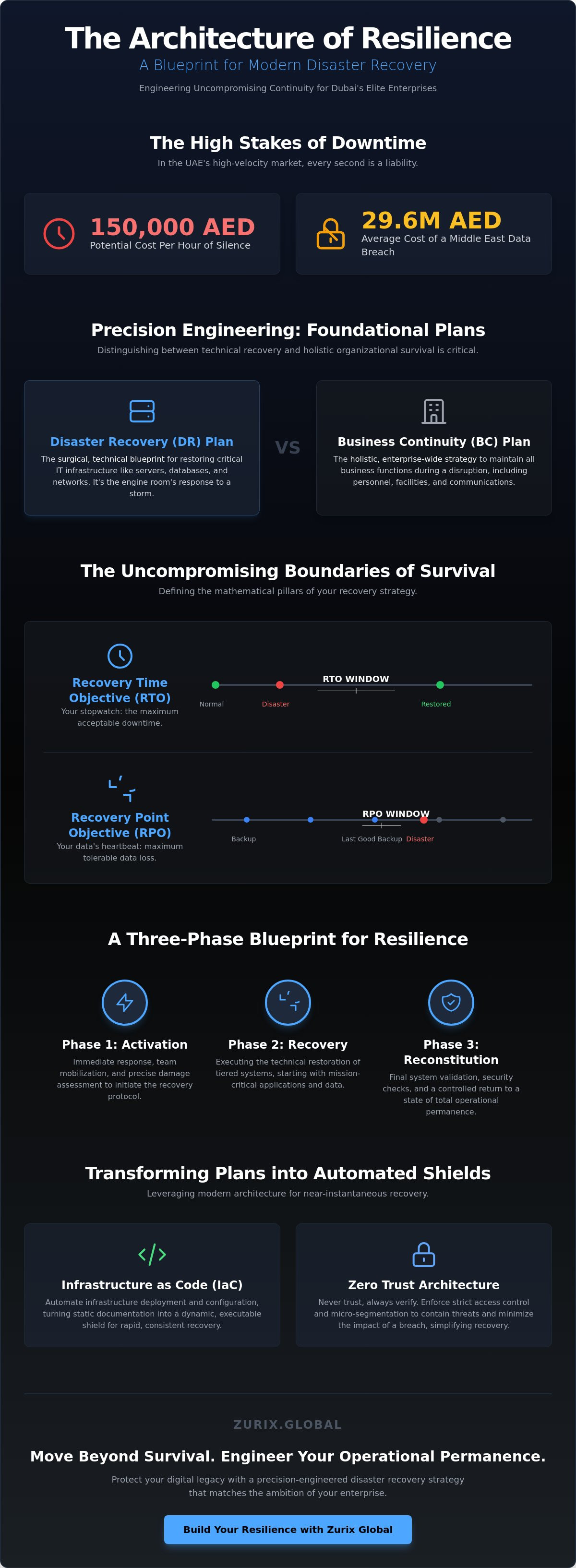
What if your sophisticated multi-cloud architecture is actually a ticking clock that could cost your Dubai-based enterprise 150,000 AED for every sixty minutes of silence? You've likely realized that in a region where cyber threats are becoming increasingly surgical, a generic disaster recovery plan is no longer a safety net; it's a liability. We understand the weight of protecting a digital legacy against the relentless pressure of SOC2 audits and the looming shadow of ransomware. It's a high-stakes engineering challenge that demands more than just basic backups.
You deserve a strategy that matches the architectural integrity of your most ambitious projects. This article provides a precision-engineered blueprint designed to transform your business continuity from a compliance checkbox into an uncompromising masterpiece of technical resilience. We'll explore how to navigate the complexities of cloud-first recovery, reduce your Recovery Time Objectives (RTO) to unprecedented levels, and ensure your infrastructure meets the most rigorous global security standards. It's time to move beyond survival and embrace a state of total operational permanence.
Key Takeaways
- Learn to distinguish between the technical precision of a disaster recovery plan and broader business continuity to ensure your UAE enterprise’s digital assets remain untouchable during critical disruptions.
- Master the engineering behind Recovery Time Objectives (RTO) and Recovery Point Objectives (RPO) through a rigorous Business Impact Analysis designed for the region's high-performance regulatory standards.
- Deploy a structured, three-phase blueprint that orchestrates every movement from initial activation to the final, uncompromising reconstitution of your enterprise’s technological core.
- Discover how Infrastructure as Code (IaC) and Zero Trust architectures transform static documentation into a dynamic, automated shield that accelerates recovery to near-instantaneous speeds.
- Explore the strategic advantage of partnering with a managed SOC to detect threats before they necessitate recovery, maintaining the elite performance and security your brand demands.
The Architecture of Resilience: Defining the Disaster Recovery Plan
A disaster recovery plan isn't a mere administrative document. It's a technical masterpiece, a structured blueprint for digital survival designed with the same precision as a high-performance workstation. In the high-stakes environment of 2026, we view this architecture as the engineering safeguard of digital assets. It represents the critical difference between a temporary operational pause and total systemic collapse. At its core, the DRP is a commitment to uncompromising performance under the most extreme pressures imaginable.
Distinguishing between technical recovery and organizational survival is vital for any visionary leader. While Business continuity planning focuses on the holistic strategy to keep an entire enterprise operational, the DRP is the surgical, technical component. It addresses the restoration of specific servers, databases, and network infrastructure. It's the engine room's response to a storm. This shift from reactive recovery to proactive resilience is mandatory. We don't just wait for failure; we architect systems that anticipate it.
The cost of failure in the United Arab Emirates is staggering. Recent industry data shows the average cost of a data breach in the Middle East reached approximately AED 29.6 million in 2024. Beyond the immediate financial drain, the damage to brand reputation in the UAE's competitive market is often irreparable. Trust takes years to build among Dubai's elite enterprises but seconds to vanish during a prolonged outage. Precision in recovery is no longer a luxury, it's a baseline requirement for survival.
Modern Threat Vectors: Why Fire and Flood Are Not Enough
Traditional risks like fires or floods have been superseded by sophisticated "digital disasters." Ransomware attacks in the region have increased significantly, targeting critical API failures and cloud-native vulnerabilities. Geopolitical instability now directly impacts data sovereignty, forcing firms to rethink their global data footprints. Traditional tape backups are obsolete in this landscape. They're far too slow for a high-velocity DevOps environment where every second of downtime costs thousands of Dirhams. Modern resilience requires real-time, immutable data protection strategies that mirror the speed of the business itself.
The Visionary Perspective on Business Continuity
Uncompromising continuity is a powerful competitive advantage. When your systems remain resilient while competitors stumble, you signal a premium brand position to the entire market. We approach this with a maximalist mindset, treating infrastructure as an art form where failure isn't an option. A robust disaster recovery plan serves as the ultimate proof of professional maturity and engineering excellence. It's how visionary leaders protect their legacy and maintain their trajectory in an unpredictable digital age. For those who demand the best, Zurix provides the hardware foundation necessary to support these high-availability visions.
Strategic Foundations: RTO, RPO, and Business Impact Analysis
Precision is the hallmark of every Zurix creation. A robust disaster recovery plan demands that same level of engineering rigor. We build this foundation on two mathematical pillars: Recovery Time Objective (RTO) and Recovery Point Objective (RPO). These aren't just IT metrics; they're the uncompromising boundaries of your business survival. RTO acts as your stopwatch, defining the exact window of time allowed to restore a service before the damage becomes irreversible. RPO functions as your data's heartbeat, determining the maximum volume of data loss your operations can tolerate during a disruption.
The Business Impact Analysis (BIA) serves as the discovery phase of this engineering process. It's where we strip away assumptions to reveal the true dependencies of your infrastructure. We utilize a "Tiered Recovery" model because we understand that not all data is created equal. Treating a non-essential archive with the same urgency as a live transaction database is a costly architectural error. By categorizing systems into tiers, we ensure that your most vital assets receive the fastest, most resilient protection while optimizing your total cost of ownership.
Calculating the Real Cost of Downtime
In the UAE's high-stakes digital economy, the financial hemorrhage from system failure is immediate and severe. For an enterprise operating in Dubai's DIFC or Abu Dhabi's Global Market, hourly losses often exceed 185,000 AED when you factor in idle workforce costs and missed opportunities. Beyond the visible cash drain, you must account for hidden costs like SLA penalties, brand erosion, and regulatory fines from the TDRA. Aligning your strategy with ISO 27001 compliance provides a globally recognized framework to establish these benchmarks with absolute certainty. It transforms resilience from a vague goal into a measurable, audit-ready standard.
Defining RTO and RPO for Cloud-Native Ecosystems
Modern resilience has evolved beyond physical hardware into the complex world of Kubernetes and microservices. In these cloud-native environments, the traditional RTO of several hours is no longer acceptable. We architect for "Near-Zero RPO" by utilizing synchronous data replication across multiple availability zones. This ensures that even if an entire data center fails, your stateful applications remain intact. To succeed, you must bridge the gap between technical execution and executive vision. When a board of directors understands that a 15-minute RPO gap represents a 500,000 AED risk, the path toward investing in premium infrastructure becomes clear. Precision in these metrics prevents the trap of over-engineering, allowing you to deploy resources with surgical accuracy.
- Tier 1 (Mission Critical): RTO < 15 mins, RPO = 0. Requires synchronous replication.
- Tier 2 (Business Vital): RTO < 4 hours, RPO < 1 hour. Snapshot-based recovery.
- Tier 3 (Supportive): RTO < 24 hours, RPO < 12 hours. Standard backup restoration.
The Zurix Blueprint: A Comprehensive DRP Template Structure
A professional-grade disaster recovery plan isn't a static manual; it's a living architectural masterpiece designed for the relentless pace of 2026. In the high-stakes digital landscape of Dubai and Abu Dhabi, where downtime can cost enterprises upwards of AED 40,000 per minute, precision is mandatory. Your blueprint must be accessible "Off-Network." If your primary infrastructure is compromised, a digital manual stored on your internal server is useless. We mandate the use of air-gapped, encrypted tablets or physical, high-security binders held by the Crisis Management Team (CMT). This team isn't a list of names; it's a specialized unit with clearly defined roles, from the Incident Commander to the Lead Recovery Architect, each possessing the authority to execute high-pressure decisions without bureaucratic delay.
Phase 1: Immediate Response and Activation
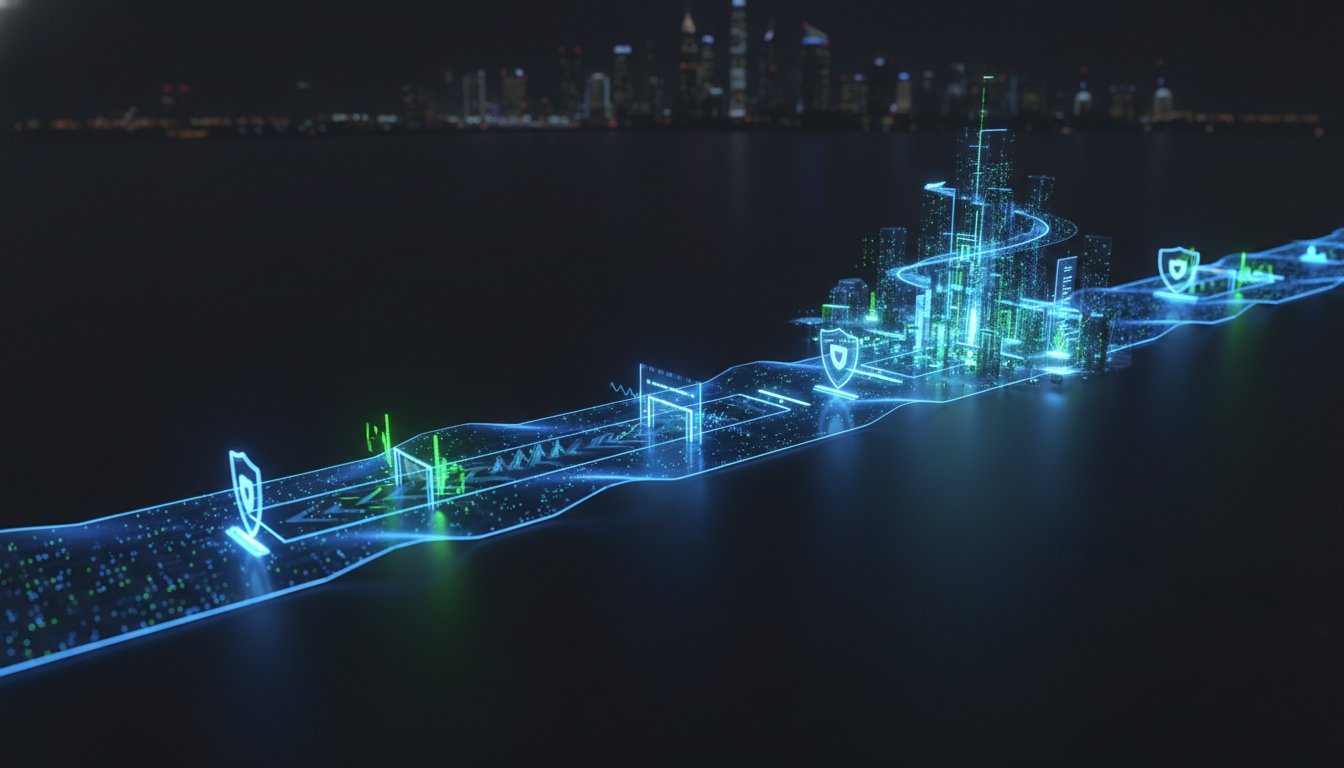
The "First 60 Minutes" checklist determines whether you control the narrative or the disaster controls you. Your protocol begins with immediate isolation of affected network segments to halt lateral movement. You can't rely on standard corporate channels during a breach. We establish secure, out-of-band communication using Signal or a dedicated, hardened Slack instance completely decoupled from your primary domain. Technical leads must complete an initial damage assessment within 20 minutes, identifying the breach vector and the extent of data corruption before the CMT authorizes the full failover sequence.
Phase 2: Technical Recovery and Failover
Restoration follows a rigorous hierarchy focused on Tier 1 critical applications. You don't just move data; you orchestrate a symphony of technical precision. Data integrity verification is the most vital step here. Statistics from 2025 indicate that 38% of failed recoveries occurred because organizations inadvertently restored encrypted ransomware from their own backups. Every data block must be validated in a sandbox environment before hitting production. For organizations that demand an uncompromising standard of safety, Zurix Global provides expert-led recovery orchestration to ensure your disaster recovery plan executes with surgical efficiency and zero margin for error.
Phase 3: Failback and Normalization
The art of the "Failback" is a delicate maneuver where operations return to the primary site. This isn't a simple toggle switch. It requires a synchronized data sync and a 48-hour stability observation period to ensure no dormant threats remain. Once the system reaches equilibrium, the post-mortem analysis begins. We treat every incident as a technical challenge to be mastered. You must update your documentation based on "lessons learned" within 72 hours. This iterative process transforms a moment of vulnerability into a blueprint for future technological superiority, ensuring your defense remains as sharp as the day it was designed.
Beyond Documentation: Testing, Automation, and Zero Trust
A disaster recovery plan isn't a static document. It's a performance. If you haven't tested your failover in the last 90 days, you don't have a plan; you have a wish list. In 2024, the Dubai Electronic Security Center (DESC) emphasized that resilience requires active, rigorous validation. Static PDFs fail when the heat rises. We treat every recovery protocol as a high-stakes engineering challenge where 99.99% uptime is the only acceptable baseline. Precision is the difference between a minor interruption and a catastrophic collapse.
Chaos Engineering isn't just for global tech giants anymore. It's a mandatory discipline for any UAE enterprise that values its digital sovereignty. By intentionally injecting failures into a controlled environment, we identify weak links before a real-world crisis does. This proactive aggression toward system vulnerabilities ensures that when a genuine disaster strikes, your response is muscle memory, not a frantic search for answers. A masterpiece of engineering must withstand the harshest conditions, and your digital infrastructure is no exception.
Automating Recovery with Infrastructure as Code
Speed is the ultimate currency during an outage. By utilizing Terraform and Ansible, we transform manual server configurations into precise, executable code. This allows for the reconstruction of entire environments in minutes rather than days. We embrace an "Immutable Infrastructure" philosophy where we don't patch broken systems; we destroy them and redeploy perfect, untainted replicas from code. Your Cloud Architecture must feature auto-healing capabilities that detect and rectify failures before a human operator even receives an alert.
The financial impact of downtime in the UAE is staggering, with some sectors losing over 25,000 AED per minute during critical outages. Automation mitigates this risk by ensuring your disaster recovery plan executes with surgical precision. It removes the variables of human fatigue and error, replacing them with the cold, reliable logic of well-crafted scripts. This isn't just efficiency; it's the art of technological survival.
Zero Trust in the Recovery Phase
Chaos is a magnet for secondary cyberattacks. During a crisis, many firms make the fatal error of granting "Emergency Access" which effectively becomes "Open Access." This is unacceptable in a modern threat environment. We implement Zero Trust principles throughout the recovery lifecycle. This means utilizing Just-In-Time (JIT) privileges where access is granted only for a specific task and revoked automatically once the work is complete. Security must remain uncompromising, even when the pressure is at its peak.
Continuous verification is the bedrock of this approach. Even during a failover to a secondary site in Abu Dhabi, every identity and device must be authenticated. Security never sleeps, especially when primary systems are down. By 2026, 80% of organizations following NESA compliance guidelines will integrate Zero Trust into their recovery phases to prevent lateral movement by opportunistic attackers. We don't just recover systems; we recover them securely, ensuring that your path back to stability doesn't open a door for a secondary breach.
Orchestrating Your Recovery: Partnering for Uncompromising Continuity
Treating a disaster recovery plan as a static document is a fundamental error in the modern threat landscape. At Zurix Global, we view resilience as a continuous managed service, an ever-evolving shield that protects your organization's digital soul. In the UAE, where the 2023 Cyber Signals report highlighted a significant rise in sophisticated infrastructure attacks, a "set and forget" mentality is a liability your brand can't afford. We don't just provide a template; we provide a living ecosystem of protection.
The true power of a modern recovery strategy lies in early detection. Our Managed SOC (Security Operations Center) serves as a sentinel, identifying the microscopic tremors of a system failure or a breach before they necessitate a full-scale recovery effort. By the time a traditional IT team notices a lag, our systems have often already isolated the threat. We bridge the gap between high-level GRC (Governance, Risk, and Compliance) consulting and deep-level technical automation. This fusion ensures that your recovery isn't just fast, it's surgically precise.
We invite you to abandon the fragility of "hope" and embrace the ironclad reality of engineered certainty. Every line of code in our automation scripts and every protocol in our governance framework is designed to ensure that your operations remain uninterrupted. We don't settle for "functional" when "flawless" is achievable. This is the hallmark of a Zurix-engineered environment.
The Zurix Difference: Expert-Led Resilience
Our 24/7 monitoring isn't a passive observation; it's an active defense. We leverage a unique synergy between DevOps automation and cybersecurity governance to create self-healing infrastructures. When a node fails in a Dubai-based cloud cluster, our automation restores it in milliseconds, often before the end-user perceives a flicker. This level of technical mastery ensures that your disaster recovery plan is never just a theory. It's a battle-tested reality. We encourage you to reach out for a comprehensive resilience audit to identify the hidden fractures in your current defense.
Next Steps: From Template to Execution
Initiate your journey toward uncompromising continuity by auditing your most critical assets today. Don't wait for a quarterly review to identify your Recovery Time Objectives. To secure stakeholder buy-in for your DR budget, frame the conversation around "digital equity." In the UAE's competitive market, downtime is more than a technical glitch; it's a public breach of trust. Presenting the ROI of resilience as a safeguard for brand reputation usually clears the path for executive approval. When you're ready to move beyond the basics and architect a digital masterpiece, Contact Zurix Global to begin your transformation.
Commanding the Future of Enterprise Continuity
Building a disaster recovery plan isn't a mere compliance exercise; it's a commitment to engineering excellence. By 2026, the margin for error in digital infrastructure will vanish. This makes RTO and RPO metrics the true measure of operational mastery. You've seen how a blueprint must evolve from a static file into a living, automated ecosystem. This requires the fusion of Zero Trust principles and DevOps-driven execution to ensure your data remains an asset, not a liability.
At Zurix Global, we treat resilience as a technological masterpiece. Our 24/7 Managed SOC Monitoring provides the constant vigilance your enterprise demands, while our ISO 27001 and GRC expertise ensures every protocol meets the highest global standards. Our DevOps-driven automation specialists transform complex recovery sequences into seamless, one-touch operations. In the rapidly evolving digital landscape of the United Arab Emirates, where the National Cybersecurity Strategy sets a high bar for infrastructure, your legacy deserves a foundation that's as ambitious as your growth. We don't just protect servers; we safeguard your vision through uncompromising performance and precision.
Architect Your Resilience with Zurix Global
Frequently Asked Questions
What is the difference between a Disaster Recovery Plan and a Business Continuity Plan?
A Business Continuity Plan (BCP) encompasses the entire organizational strategy to maintain operations during a crisis, whereas a disaster recovery plan focuses specifically on the restoration of critical IT infrastructure and data integrity. Think of BCP as the grand architectural vision for survival and DRP as the precise engineering blueprint that brings the systems back to life. While BCP addresses human resources and physical workspace, the DRP ensures your digital masterpiece remains functional under pressure.
How often should we test our disaster recovery plan?
You must test your disaster recovery plan at least twice every twelve months to ensure its uncompromising reliability. Leading organizations in Dubai often conduct quarterly drills to align with the Dubai Electronic Security Center (DESC) standards. Static plans are mere artifacts. Only through rigorous, high-stakes simulation can you guarantee that your recovery time objectives will hold firm when a real crisis strikes the UAE's digital landscape.
What are the most common mistakes in disaster recovery planning?
The most frequent failure is the reliance on outdated documentation, which accounts for 45% of recovery bottlenecks according to 2024 industry audits. Many firms fail to define precise Recovery Time Objectives (RTO) for every individual service. They treat DRP as a box-ticking exercise rather than a living engineering challenge. This lack of granular detail leads to chaos when technical teams face high-pressure restoration scenarios without a clear, masterfully designed roadmap.
Does a cloud-first strategy eliminate the need for a DRP?
A cloud-first strategy doesn't eliminate the need for a DRP; it simply shifts the architectural focus to configuration and cloud-native resilience. You're still responsible for your data's integrity and availability under the Shared Responsibility Model. Relying solely on a provider's uptime is a dangerous gamble. You need a custom-designed strategy to handle regional outages or accidental deletions within the cloud environment itself to maintain peak performance.
How does ransomware affect disaster recovery procedures?
Ransomware transforms recovery from a speed challenge into a forensic masterpiece. Modern attacks now target backup repositories in 75% of cases, forcing teams to implement immutable storage and isolated clean rooms for restoration. You can't just fail over to a secondary site if the data there is already encrypted. Your procedures must include rigorous scanning and validation to ensure you aren't restoring the very infection that crippled your primary systems.
What is a warm site vs. a hot site in disaster recovery?
A hot site acts as a mirror image of your primary data center, offering near-instantaneous failover for mission-critical workloads. It represents the pinnacle of redundancy. Conversely, a warm site contains the necessary hardware and connectivity but requires several hours to load backups and stabilize configurations. While a warm site reduces costs, only a hot site provides the uncompromising performance required for tier-one financial services in the Abu Dhabi Global Market.
Can we automate the entire disaster recovery process?
You can automate the orchestration of failover sequences, but the final decision to trigger a disaster declaration remains a human prerogative. Automation tools eliminate the risk of manual error during complex server boot orders. They turn a chaotic recovery into a choreographed symphony of technical precision. However, expert oversight ensures that the automated scripts align with the unique nuances of your specific environment during an unprecedented event.
How do I align my DRP with ISO 27001 requirements?
Aligning your DRP with ISO 27001 requires strict adherence to Annex A.17, which focuses on information security continuity during disruptions. You must document every technical control and recovery procedure to satisfy the rigorous audit requirements of the 2022 standard update. This isn't just about compliance; it's about building a fortress of trust that proves to your UAE partners that your digital assets are protected by world-class engineering standards.