
Would you intentionally commit $2 million to an infrastructure project that begins to age the moment it's commissioned? Building a 24/7 in-house Security Operations Center in 2026 requires an initial investment of up to $2 million, yet a global workforce gap of 4.8 million professionals makes staffing that facility an exercise in frustration. You're likely feeling the pressure of the UAE National Cyber Security Strategy and the urgent need for NCAP accreditation while your current team struggles with overwhelming alert fatigue. The business case for managed soc services isn't just a cost-saving tactic; it's a strategic engineering mandate to implement a masterpiece of resilience that decouples your company's growth from digital risk.
We recognize that you demand uncompromising performance and view security as a pillar of operational excellence rather than a mere cost center. This article provides a comprehensive framework to help you evaluate and justify a Managed SOC that transforms your defense into a high-performance asset. You'll gain access to a clear ROI model, a breakdown of 2026 regulatory alignment, and a roadmap to secure 24/7 protection without the $1.5 million annual overhead of an internal team.
Key Takeaways
- Understand why passive firewalls are obsolete and how the fusion of human intelligence and AI creates a proactive defense against 2026's multi-stage threats.
- Analyze the financial framework and the business case for managed soc services to avoid the $2 million initial infrastructure cost and elite staffing hurdles of an internal build.
- Navigate the complex UAE regulatory landscape with continuous monitoring strategies that ensure seamless compliance with NESA and the National Cyber Security Strategy.
- Learn to quantify security ROI for the Board by measuring Mean Time to Respond (MTTR) and the massive cost savings of automated threat hunting.
- Discover the power of "Security as Code" and how integrating SOC alerts into your DevOps pipeline creates a masterpiece of automated infrastructure resilience.
The Strategic Imperative: Why Traditional Security Fails in 2026
Passive security measures like firewalls and traditional antivirus have become relics of a simpler era. In 2026, relying on these tools alone is like guarding a vault with a padlock while the thieves are using quantum drills. Modern threats are sophisticated, multi-stage campaigns that bypass perimeter defenses with surgical precision. To survive, organizations must shift from a posture of simple protection to one of total digital resilience. This shift is the core of the business case for managed soc services. A modern Security Operations Center (SOC) is no longer just a room full of monitors; it's a high-performance fusion of elite human intelligence and AI-driven automation designed to anticipate, not just react. We don't just install software. We engineer a fortress.
Staffing a 24/7 internal team in the UAE has become nearly impossible for most enterprises. With a global cybersecurity workforce gap reaching 4.8 million unfilled positions, elite talent is both scarce and prohibitively expensive. Attempting to build this capability in-house often leads to a revolving door of junior staff who can't keep up with the complexity of modern attacks. A Managed SOC solves this by providing immediate access to a world-class engineering team without the internal overhead. It's about achieving a state of uncompromising performance where security enables, rather than hinders, your vision.
The Evolution of the Threat Landscape
The battlefield has changed. We've moved beyond simple malware into the era of AI-powered ransomware and intricate supply chain attacks that target the very foundation of your operations. These threats don't just hit your servers; they exploit the subtle complexities of hybrid cloud environments and Kubernetes clusters. If your security isn't as dynamic as your infrastructure, you're vulnerable. The Managed SOC serves as the central nervous system of a resilient enterprise, synchronizing defense and recovery in a single, elegant motion.
The "Alert Fatigue" Crisis
Most organizations are drowning in data but starving for insights. Unmanaged security tools generate a relentless cacophony of noise that masks the subtle signals of a critical breach. This "alert fatigue" isn't just a technical nuisance; it's a profound business risk that leaves the door wide open for attackers. While traditional monitoring relies on brute-force data collection, the Zurix philosophy centers on precision engineering over mindless observation. We transform the chaotic noise of unmanaged tools into the clear signal of actionable intelligence. Our expert analysts don't just watch screens. They hunt. They ensure that every alert is a step toward resolution, not just another line in a log file.
Build vs. Buy: A Financial Analysis of Managed SOC Services
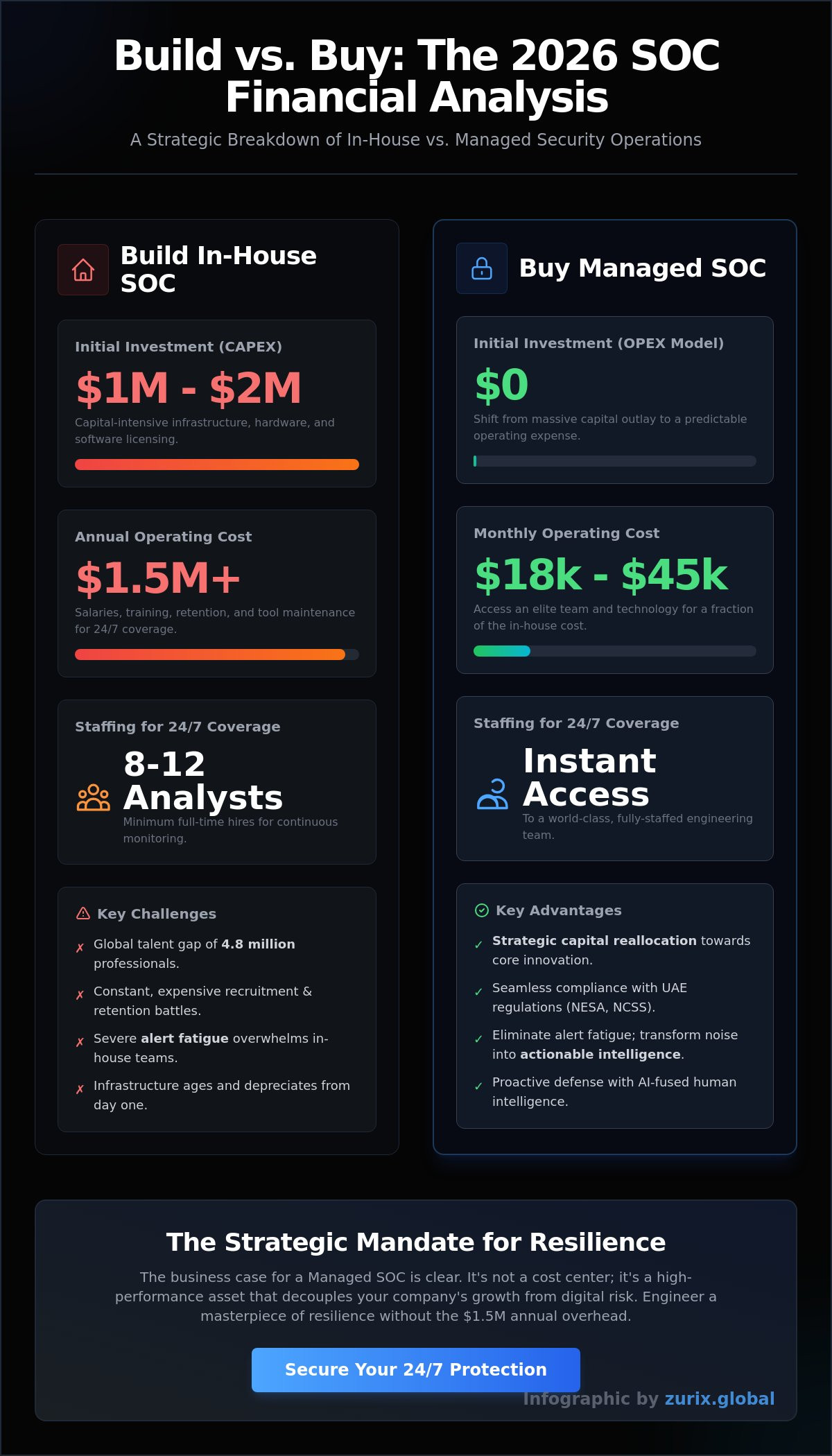
Choosing between an in-house build and a managed partnership isn't just a technical decision; it's a cold-blooded financial calculation. Building an internal SOC in 2026 demands a staggering initial infrastructure investment of approximately $1 million to $2 million. This is CAPEX intensive. It locks capital into hardware and software that depreciates while the threat landscape evolves. The business case for managed soc services rests on the shift to a predictable OPEX model. Instead of million-dollar outlays, enterprises can access elite protection for $18,000 to $45,000 per month. This isn't just a cost saving. It's a strategic reallocation of capital toward core innovation.
True 24/7 coverage is an engineering challenge in itself. You don't just need "a team"; you need a minimum of 8 to 12 full-time analysts to account for shift rotations, holidays, and inevitable sick leave. With senior SOC analysts commanding salaries up to $140,000 and managers reaching $160,000, the annual payroll alone for a basic capability starts at $1.2 million. Advanced hunting capabilities can easily push that figure past $3 million. This financial burden is often unsustainable for organizations that aren't dedicated cybersecurity firms.
The Hidden Costs of an In-House SOC
Beyond the visible payroll, the hidden costs of an internal build are often where budgets go to die. The specialized UAE cybersecurity market is exceptionally competitive. Recruitment and retention are constant battles. When a senior analyst leaves, you're not just losing a staff member; you're losing the institutional knowledge of your specific environment. You also bear the full burden of SIEM platforms ($40,000 to $300,000+ annually) and SOAR tools ($30,000 to $80,000). By outsourcing, these technology costs are absorbed by the provider. This allows you to align with the UAE's National Cyber Security Strategy without the crushing weight of direct ownership.
Scaling with Business Growth
A Managed SOC offers an elastic capacity that internal teams simply cannot match. If your business expands into new markets or acquires a subsidiary, a managed partner can scale your monitoring in days. An internal build would take months or even years to recruit and train the necessary talent. Speed is a competitive advantage. We believe that security should move at the pace of your vision. If you're ready to stop managing tools and start engineering resilience, consulting with Zurix Global provides the blueprint for rapid, secure scaling that traditional models can't touch.
Compliance as a Competitive Edge: The UAE Regulatory Landscape
In the ultra-competitive UAE market, compliance isn't a burden; it's a badge of engineering excellence. C-suite leaders often view regulatory frameworks as static hurdles, but the reality in 2026 is far more dynamic. A Managed SOC transforms compliance from a reactive audit nightmare into a proactive competitive edge. This shift is a vital pillar of the business case for managed soc services, as it allows organizations to demonstrate the "Continuous Monitoring" that global standards and local laws now demand. When you can prove real-time visibility into your infrastructure, you don't just pass audits. You win the trust of Tier-1 enterprise partners who demand uncompromising security standards.
As highlighted in The Evolution of the Modern SOC, these centers have transitioned from technical silos to business enablers. For organizations operating in the Middle East, this means aligning with the ISO 27001 Compliance in the UAE framework and the expanding local mandates. We don't settle for "good enough" compliance. We aim for total transparency and precision in every report we generate.
Meeting NESA and SIA Mandates
Critical information infrastructure and government-linked entities in the UAE face rigorous reporting requirements. The National Electronic Security Authority (NESA) mandates specific controls that are nearly impossible to maintain through manual oversight. The business case for managed soc services becomes undeniable when you realize that the National Cyber Accreditation Programme (NCAP), rolling out in 2026, restricts unaccredited providers for critical infrastructure. A Managed SOC automates the evidence collection process. It creates a digital paper trail of every incident and remediation effort. This turns Governance, Risk, and Compliance (GRC) from a manual drain on resources into a natural, automated output of your security operations.
Data Sovereignty and Privacy
The expansion of Federal Decree-Law No. 34 of 2021 in 2026 introduced even stricter rules on user consent and local data storage. Failing to protect personal data isn't just a security failure; it's a legal catastrophe. Rapid incident response is the only way to mitigate the fines associated with data breaches, which can reach millions of dirhams. By leveraging a SOC with deep local expertise, you ensure that your data handling meets the specific requirements of UAE-approved data centers. This isn't just about avoiding penalties. It's about securing your reputation in a region that values discretion and reliability above all else.
Quantifying ROI: Measuring the Value of Prevention and Response
Boards of directors rarely speak the language of SIEM logs or packet inspections; they speak the language of risk mitigation, capital efficiency, and return on investment. To build a compelling business case for managed soc services, leaders must translate technical resilience into measurable financial outcomes. In 2026, the global average cost of a data breach has reached a staggering $4.88 million. For organizations that haven't embraced automation, this figure represents a direct hit to the bottom line. However, companies that deploy extensive security AI and automation save an average of $2.22 million per incident. This isn't just about avoiding a loss. It's about engineering a more profitable, stable enterprise.
Beyond the immediate costs of remediation, a Managed SOC provides a hidden financial benefit: reduced insurance premiums. As cyber-liability insurers become more selective, they're demanding proof of 24/7 monitoring and rapid incident response. Demonstrating a partnership with an elite SOC provider often moves your organization into a lower risk bracket. This results in significant annual savings on coverage. We view security not as an insurance policy, but as a high-performance asset that pays dividends through operational continuity and lower overhead.
The MTTD and MTTR Framework
The ultimate ROI metric for any visionary leader is the drastic reduction of detection and response windows. Traditional security models often allow attackers to linger in a network for months before discovery. A Managed SOC flips this script. By utilizing Security Orchestration, Automation, and Response (SOAR), we reduce the Mean Time to Detect (MTTD) and Mean Time to Respond (MTTR) from weeks to mere minutes. Every minute saved in response equals thousands of dollars in preserved revenue. In a world where a malicious insider attack can cost $4.92 million, speed is the only variable that truly matters.
Protecting Brand Equity
In the UAE's tightly-knit and highly competitive business landscape, trust is the most valuable currency. A single public security failure can erase decades of reputation-building in an afternoon. Proactive threat hunting ensures that "silent" breaches are neutralized before they can ever evolve into public scandals. This level of vigilance is part of The Art of Proactive Cybersecurity, where we treat your digital infrastructure as a masterpiece that must be protected at all costs. Resilience isn't just about technical uptime; it's about the enduring strength of your brand in the eyes of your most important clients.
If you're ready to transform your security from a cost center into an engineering masterpiece of resilience, consult with our experts at Zurix Global to build your custom ROI roadmap today.
The Zurix Advantage: Integrating SOC with DevOps and Cloud Architecture
Traditional security providers often treat defense as a siloed function, a fence erected around a building after it's already finished. At Zurix Global, we reject this fragmented approach. We believe that true resilience is engineered into the very fabric of your digital infrastructure. The business case for managed soc services reaches its full potential when security is fused with DevOps and Automation. This integration creates what we call "Security as Code," where SOC alerts don't just sit in a queue; they trigger automated infrastructure remediation. It's a self-healing ecosystem that doesn't just watch for trouble but actively maintains its own integrity. We don't just monitor your network; we orchestrate its survival.
Our commitment to uncompromising performance means we provide 24/7 expert-led support that functions as a high-performance extension of your internal team. Based in the UAE, our delivery capabilities are tuned to the specific technical and regulatory pulse of the region. We don't settle for generic monitoring. We offer a partnership that treats your security as a personal mission and an engineering challenge. When you partner with Zurix Global for a Secure IT Ecosystem, you're not just buying a service; you're commissioning a masterpiece of digital defense.
Security-First Cloud Architecture
We design secure foundations from the ground up using Zero Trust principles and robust Kubernetes security protocols. This proactive design philosophy ensures that your environment is resilient by default. There's a profound synergy between visionary Cloud Architecture and continuous monitoring. By building with security in mind, we reduce the attack surface and make the SOC's job one of precision rather than chaos. Every cluster and container we deploy is a testament to our dedication to technical excellence and professional depth.
The Path Forward: From Business Case to Implementation
Moving from a strategic vision to a fully operational Managed SOC is a journey of precision engineering. We begin with a rigorous gap analysis and comprehensive asset discovery to ensure no corner of your digital estate is left in the shadows. Onboarding is a structured, elegant process designed to minimize friction while maximizing visibility. We don't believe in "good enough" transitions. Our team works alongside yours to ensure that every alert, every playbook, and every automated response is tuned to your specific operational requirements. The protection we offer is uncompromising, rending the impossible possible through relentless innovation and engineering humbleness. The future of your enterprise demands nothing less than perfection.
Mastering the Architecture of Digital Resilience
The landscape of 2026 demands more than passive defense; it requires an engineering mindset that views security as an inseparable component of your digital infrastructure. We've seen that the business case for managed soc services rests on decoupling your company's growth from the $2 million burden of internal builds while securing total alignment with UAE mandates like NESA and ISO 27001. By fusing 24/7 expert-led monitoring with pioneering DevOps integration, you transform your threat defense into a proactive, self-healing masterpiece. This isn't just about avoiding the $4.88 million average cost of a breach. It's about building a foundation of trust that enables your most ambitious digital visions to flourish without compromise.
Your journey toward a secure, scalable, and compliant future doesn't have to be a solo mission. Our visionary experts are ready to translate these technical efficiencies into your specific business success. Engineering your resilient digital future starts here; contact Zurix Global for a tailored SOC proposal. We don't just protect your data. We engineer the peace of mind you need to lead your industry with confidence.
Frequently Asked Questions
What is the primary difference between an MSSP and a Managed SOC?
An MSSP typically focuses on administrative device management, such as firewalls and VPNs, while a Managed SOC provides deep, intelligence-led threat detection and response. We view a SOC as the elite engineering layer that analyzes telemetry to proactively hunt for sophisticated adversaries. While an MSSP keeps the lights on, a Managed SOC ensures your digital fortress is actively defended by human experts and high-performance AI.
How does a Managed SOC help with NESA compliance in the UAE?
A Managed SOC directly addresses NESA's mandate for continuous security monitoring and rapid incident response. We automate the evidence collection required for rigorous audits, transforming compliance from a manual burden into a technical masterpiece of transparency. This systematic approach is a cornerstone of the business case for managed soc services, ensuring your organization remains aligned with the UAE National Cyber Security Strategy without exhausting internal resources.
Can a Managed SOC integrate with our existing DevOps and Kubernetes workflows?
Our Managed SOC is specifically engineered to integrate with modern DevOps pipelines and Kubernetes clusters. We treat security as code, injecting monitoring and automated remediation directly into your CI/CD workflows. This synergy ensures that containerized environments are monitored for misconfigurations and runtime threats in real-time. It's not just a standalone service; it's a fusion of security and high-performance cloud architecture designed for the 2026 threat landscape.
What are the typical onboarding timelines for Managed SOC services?
Initial asset discovery and baseline monitoring typically begin within days of commissioning. A full, high-precision tuning of your environment generally takes between two to four weeks. We follow a meticulous engineering roadmap that includes gap analysis and playbook development. This disciplined approach ensures that your transition to 24/7 protection is seamless, professional, and uncompromisingly thorough from the very first hour of operation.
How do we calculate the ROI of a SOC if we haven’t had a major breach yet?
Calculating ROI involves measuring the reduction in cyber-liability insurance premiums and the avoidance of "silent" breach costs like data exfiltration. Organizations that deploy security AI and automation save an average of $2.22 million per incident compared to those who don't. Even without a public breach, the business case for managed soc services is proven through improved operational uptime and the liberation of your internal team for core innovation.
Is a Managed SOC suitable for small to medium-sized enterprises in the UAE?
Managed SOC services are highly suitable for UAE-based SMEs that face the same sophisticated threats as enterprises but lack the $2 million budget for an internal build. We offer a scalable subscription model that provides elite, 24/7 protection without the crushing overhead of 12 full-time analysts. This allows smaller organizations to compete for larger contracts by demonstrating a mature, enterprise-grade security posture that commands respect from Tier-1 partners.
Does a Managed SOC replace our internal IT team?
A Managed SOC does not replace your internal IT team; it serves as a specialized extension of their capabilities. While your IT staff focuses on strategic growth and user support, our SOC experts handle the relentless, 24/7 task of threat hunting and incident response. This partnership allows your internal talent to escape alert fatigue and focus on the engineering challenges that drive your business forward with uncompromising performance.
How does Zurix Global handle data sovereignty for UAE-based clients?
Zurix Global ensures total data sovereignty by utilizing UAE-approved data centers and adhering to Federal Decree-Law No. 34 of 2021. We understand the technical and legal nuances of storing personal data within the region. Our architecture is designed to keep your sensitive telemetry within local borders, providing the exclusivity and security that high-tier UAE enterprises demand for their most valuable digital assets and masterpieces.