

Why does the board still view your security architecture as a burdensome tax rather than a precision-engineered masterpiece of corporate resilience? With global cybercrime costs surging toward $10.5 trillion in 2026, treating your defense as a secondary IT concern isn't just a mistake; it's a failure of vision. You've likely felt the cold wall of budget fatigue when trying to explain why a $9.44 million average data breach cost in the U.S. justifies a higher investment today. It's frustrating to quantify the "prevention" of a catastrophe that hasn't occurred, especially when leadership demands a direct link between security tools and the bottom line.
This guide will transform your approach, teaching you exactly how to justify cybersecurity budget to the board by translating raw technical data into a compelling narrative of financial protection. We'll show you how to leverage the strict mandates of the Digital Operational Resilience Act (DORA) and the updated California Privacy Rights Act (CPRA) to secure the investment your organization demands. We'll explore the shift from defensive spending to strategic growth, ensuring your next proposal is met with buy-in instead of skepticism.
Key Takeaways
- Learn to bridge the communication gap by translating complex technical vulnerabilities into a vision of digital resilience that aligns with core business objectives.
- Master precision-driven financial modeling using ALE and SLE formulas to quantify the exact impact of downtime and legal liabilities on your organization's bottom line.
- Discover how to justify cybersecurity budget to the board by positioning compliance mandates like DORA as essential, non-negotiable foundations for competitive stability.
- Optimize your security investment through automation and "Shift Left" philosophies that dramatically reduce manual labor while increasing the performance of your technical architecture.
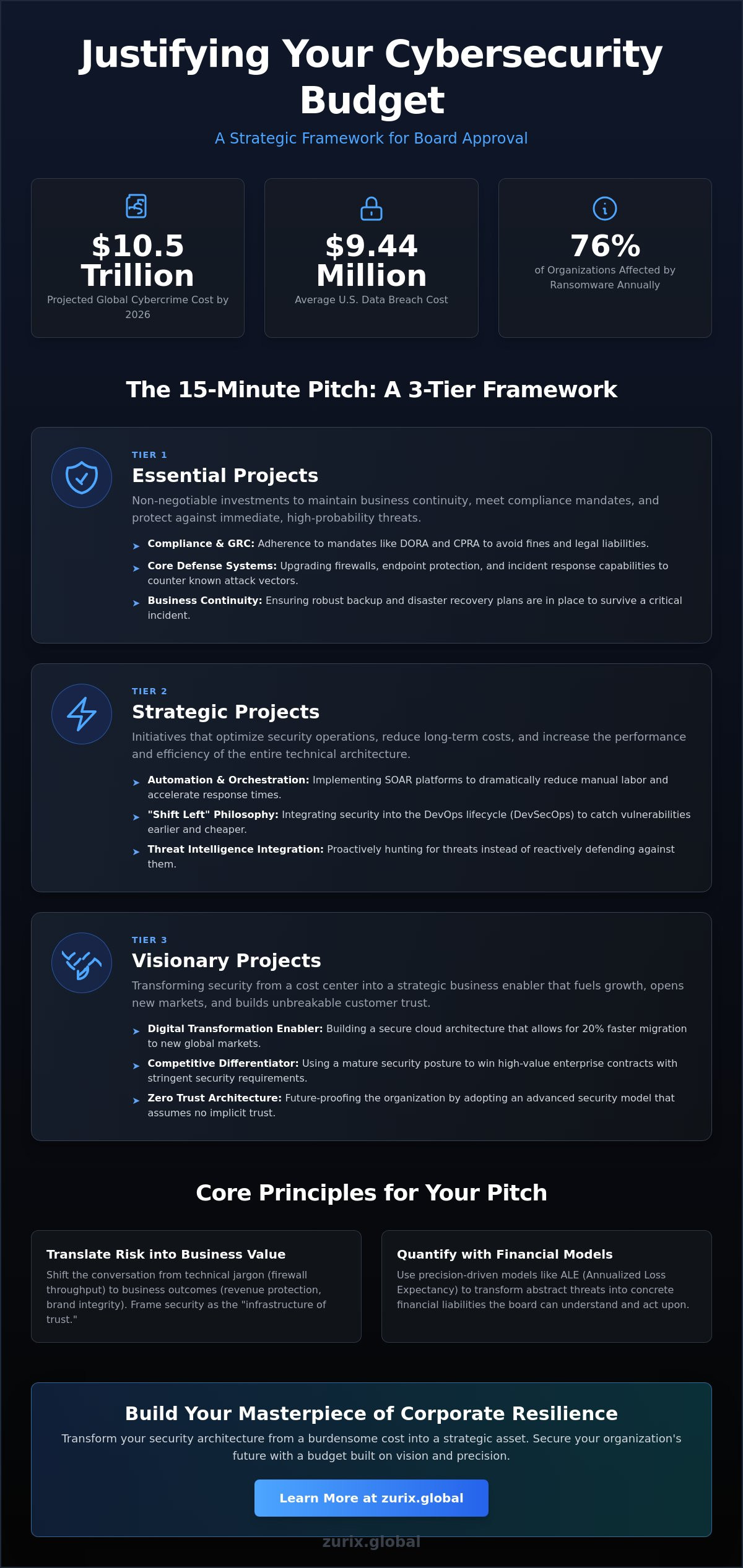
- Adopt a strategic three-tier framework to deliver a compelling 15-minute pitch that secures immediate approval for essential, strategic, and visionary security projects.
Bridging the Communication Gap: Translating Cyber Risk into Business Value
The board of directors often perceives cybersecurity as an opaque, bottomless pit of expenditure. This "black box" mentality persists because technical leaders frequently fail to translate engineering precision into the language of fiscal stewardship. While your team tracks a 15% increase in global security spending, projected to hit $183.9 billion in 2026, the board sees only a rising cost center that never seems satisfied. To succeed, you must pivot. You aren't just buying software; you're constructing a masterpiece of corporate resilience that protects the very heartbeat of the enterprise.
Mastering how to justify cybersecurity budget to the board requires a fundamental shift from technical metrics to business outcomes. Directors don't care about the number of blocked port scans or the nuances of zero-day exploits. They care about revenue protection, margin preservation, and brand reputation. When you position security as the "infrastructure of trust," you transform it from a grudge purchase into a strategic asset. High-performance organizations recognize that uncompromising security is the only way to safeguard a brand's most valuable currency: its integrity.
The Language of the Board: Risk, Not Features
Stop discussing firewall throughput and start discussing business continuity. Every technical threat must be mapped to a specific business process. If a ransomware attack affects 76% of organizations annually, the board needs to know exactly which revenue streams will freeze if your defenses fail. You should move away from the psychological trap of "Fear, Uncertainty, and Doubt." Instead, present a vision of confidence and growth. By utilizing the NIST Cybersecurity Framework, you provide a structured, authoritative roadmap that turns abstract fears into manageable, quantified risks. This professional approach demonstrates that you aren't just reacting to headlines; you're executing a calculated engineering strategy.
Cybersecurity as a Strategic Business Enabler
Robust security isn't a brake on the business; it's the high-performance suspension that allows you to drive faster. In 2026, the ability to demonstrate a mature security posture is a prerequisite for securing high-value enterprise contracts. This is especially true when pursuing aggressive digital transformation. A secure Cloud Architecture serves as the foundational masterpiece for global expansion, allowing for faster market entry without compromising the organization's crown jewels. When security enables a 20% faster migration to new markets or satisfies the stringent requirements of a Tier-1 partner, the budget isn't an expense. It's the fuel for your next major victory.
Quantifying the Incalculable: Financial Risk Modeling for Cybersecurity
To a board of directors, qualitative adjectives like "critical" or "dangerous" are mere shadows. They demand the cold, hard light of mathematical certainty. Precision is the hallmark of a master, and in the boardroom, that precision is expressed through financial risk modeling. You cannot expect approval for a high-performance security architecture if you cannot articulate the exact fiscal weight of the risks you intend to mitigate. Transitioning from technical anxiety to financial clarity is the only way to demonstrate that your budget is a calculated investment in the company's survival.
Mastering how to justify cybersecurity budget to the board requires moving beyond surface-level estimates. You must present a defensible, data-driven narrative that mirrors the rigor of a CFO's own balance sheet. By utilizing established formulas, you transform abstract threats into concrete liabilities. This approach doesn't just ask for money; it presents a plan to preserve millions in shareholder value. When you justify your cybersecurity budget with this level of engineering discipline, you prove that security is a core component of the organization's financial health.
Defining Annual Loss Expectancy (ALE)
Annual Loss Expectancy (ALE) represents the mathematically projected cost your organization will incur from security incidents over a twelve-month period. To calculate this, you first determine the Single Loss Expectancy (SLE) by multiplying the Asset Value by the Exposure Factor. For instance, with the average cost per compromised record in the United States hitting $180 in 2026, a database of 50,000 records carries a base SLE of $9 million. You then multiply this by the Annual Rate of Occurrence (ARO). Given that ransomware now affects 76% of organizations annually, an ARO of 0.76 is a statistically sound benchmark for your model. The resulting ALE provides a clear, high-stakes figure that anchors your budget request in reality.
Beyond the Formula: Indirect Costs of a Breach
The true cost of a breach extends far beyond the immediate recovery. You must account for the 277 days it takes, on average, to identify and fully contain a data breach. During this period, customer churn and brand erosion can devastate your margins. In 2026, the "Cost of Inaction" also includes the heavy weight of regulatory scrutiny, as seen with the $9.80 million average breach cost in the healthcare sector. Building a Risk Heat Map allows you to visualize these variables for the board, showing exactly where your current defenses might buckle under pressure. To ensure your infrastructure remains a masterpiece of reliability, explore how our uncompromising engineering standards can solidify your digital resilience. This level of transparency builds the trust necessary for long-term strategic buy-in.
Compliance as a Competitive Edge: Mapping Budget to GRC Requirements
Many leaders view compliance as a finish line. In reality, it's merely the foundation upon which true digital excellence is built. You must help the board understand that meeting regulatory requirements is the "floor" of security; it's the minimum standard required to remain in the arena. In 2026, compliance isn't a bureaucratic checkbox. It's a precision-engineered shield that protects the organization from the crushing weight of regulatory penalties and reputational ruin. When you frame your request this way, you aren't just asking for funds. You're securing the company's license to operate in an increasingly scrutinized global market.
Understanding how to justify cybersecurity budget to the board involves reframing these mandates as non-negotiable pillars of stability. Consider the Digital Operational Resilience Act (DORA), which took full effect in January 2026. For financial institutions and their partners, DORA isn't optional; it's a mandate for real-time risk monitoring and active resilience testing. The financial impact of non-compliance is staggering. When compared to the $4.88 million global average cost of a data breach, the investment required for robust Governance, Risk, and Compliance (GRC) tools is a masterstroke of fiscal responsibility. You're choosing a controlled, strategic investment over the chaotic, unquantified costs of a legal crisis.
The ROI of Governance, Risk, and Compliance (GRC)
A sophisticated GRC framework provides a blueprint for efficient spending. It eliminates the waste of redundant security tools and reduces audit fatigue through centralized management. By automating compliance workflows, you free your elite engineering talent to focus on innovation rather than manual documentation. Beyond internal efficiency, strong GRC becomes a formidable marketing asset. In a world where 76% of organizations face annual ransomware attacks, being able to prove your security maturity through a ISO 27001 Compliance framework is a powerful trust signal that wins high-value enterprise contracts.
Navigating UAE and Global Standards
Budgeting for the modern era requires a dual focus on local precision and global reach. In the UAE, NESA compliance is essential for critical infrastructure; it demands a budget that prioritizes continuous monitoring over one-time audits. Simultaneously, new US state privacy laws in Indiana, Kentucky, and Rhode Island, alongside updated CPRA regulations effective January 1, 2026, mandate rigorous cybersecurity audits. These aren't just technical hurdles. They're strategic requirements. By aligning your budget with these global standards, you transform security into a "passport" for international expansion, ensuring your business remains agile and uncompromised on the global stage.
The Efficiency Argument: Leveraging Automation and DevOps to Optimize Spend
Efficiency is the ultimate proof of engineering mastery. In the high-stakes environment of 2026, the board no longer accepts "more spending" as a solution to rising threats. They demand optimization. Learning how to justify cybersecurity budget to the board is often a matter of demonstrating operational ROI through the lens of automation. When you replace manual, error-prone processes with precision-engineered automated workflows, you aren't just saving time. You're eliminating the vulnerabilities that human fatigue inevitably creates. This is where security transcends its role as a cost center and becomes a model of operational excellence.
The "Shift Left" philosophy is your most powerful financial argument. Investing in security during the initial design phase of a project is statistically ten times more cost-effective than attempting to patch a production environment after a breach. This proactive stance aligns perfectly with the 15% increase in global security spending projected for 2026. By building security into the DNA of your projects, you ensure that your digital architecture remains a masterpiece of resilience rather than a patchwork of emergency fixes. Precision at the start prevents catastrophe at the end.
DevSecOps: Building Security into the Pipeline
Modern delivery requires a compromise-free approach to speed and safety. Infrastructure as Code (IaC) isn't just a technical preference; it's a financial safeguard that eliminates configuration drift. By utilizing Kubernetes and containerization, your team can manage complex environments with unprecedented clarity. Automated scanning within the CI/CD pipeline reduces the cost per vulnerability by identifying flaws before they reach the real world. This immutable infrastructure ensures that every deployment is a clean, verified success, protecting your organization from the 277-day average identification period that plagues less disciplined firms.
Maximizing Human Capital with Managed Services
The math of 24/7 monitoring is relentless. Building a full-scale, in-house Security Operations Center (SOC) in 2026 requires a massive headcount that most organizations find unsustainable. Managed services allow you to bridge the cybersecurity skills gap without the crushing overhead of recruitment and retention in a hyper-competitive market. By offloading routine monitoring to elite specialists, your internal team can focus on high-level strategic initiatives that drive revenue. Secure your digital future with Zurix Global's elite delivery capabilities, where we treat your security architecture as a unique engineering challenge that demands nothing less than perfection.
Presenting the Masterpiece: A Strategic Framework for Board Approval
The final fifteen minutes in the boardroom represent the culmination of your engineering vision. It's the moment where technical precision meets executive decision making. You shouldn't just present a spreadsheet; you must unveil a strategic masterpiece. Understanding how to justify cybersecurity budget to the board requires a structured, three-tier approach that categorizes investments into Essential, Strategic, and Visionary components. This clarity allows directors to see exactly where they're maintaining the status quo and where they're investing in the future of the enterprise. High-performance security is a promise of performance.
Visualizing success is just as vital as quantifying risk. Use high-fidelity dashboards to show year-over-year value, demonstrating how previous investments have successfully compressed the 277-day average containment window. When you present security as a precision-engineered foundation, the conversation shifts from "How much does this cost?" to "How quickly can we deploy it?" This is the hallmark of a visionary leader. You aren't just defending a perimeter. You're guaranteeing the organization's ability to innovate without compromise.
The 5-Step Board Presentation Blueprint
Structure your pitch for maximum impact using this professional roadmap:
- Step 1: The Executive Summary. Lead with business outcomes. State how the budget protects the $9.44 million average cost of a U.S. breach rather than listing software licenses.
- Step 2: The Risk Landscape. Present the Annual Loss Expectancy (ALE) alongside a gap analysis. Show them where the $10.5 trillion global cybercrime threat intersects with your specific operations.
- Step 3: The Strategic Roadmap. Detail how this specific budget achieves long-term resilience through architectural excellence.
- Step 4: The ROI Case. Highlight the efficiency gains from the automation and DevOps strategies discussed earlier.
- Step 5: The Call to Action. Define the next steps for immediate implementation.
Handling Board Objections with Precision
Anticipate skepticism with the calm confidence of an expert. When asked, "Why haven't we been hacked yet?", explain that luck is not a strategy. Remind the board that 76% of organizations face annual attacks, and past safety is a result of previous precision, not a guarantee of future immunity. Address the cyber insurance debate by highlighting that insurers now demand evidence of strong controls, like those in the CPRA or DORA frameworks, before offering coverage. Finally, emphasize the "Cost of Delay." Waiting six months to fund a project doesn't just stall progress; it leaves a $4.88 million global average liability on the table every single day. Precision demands action now.
Architecting a Future of Uncompromising Resilience
The transition from technical gatekeeper to strategic visionary is now complete. By translating raw risk into the Annual Loss Expectancy models and efficiency gains explored in this guide, you've built a compelling case for investment. You understand that in 2026, security is the precision-engineered foundation of every high-performance organization. Mastering how to justify cybersecurity budget to the board isn't just about securing funds; it's about guaranteeing the integrity of your company's digital masterpiece. Precision in the boardroom leads to protection in the field.
True excellence requires a partner who shares your obsession with perfection. Whether you're implementing Zero Trust within Kubernetes environments or navigating the complexities of NESA and ISO 27001 compliance, the right expertise is non-negotiable. Our 24/7 Security Operations Center provides the relentless vigilance your enterprise demands. Don't leave your organization's resilience to chance. Secure your digital masterpiece with Zurix Global’s expert consulting and ensure your technical vision remains uncompromised. The future belongs to those who build with precision and lead with confidence.
Frequently Asked Questions
How do I calculate the ROI of a security tool that hasn’t been implemented yet?
Calculate Return on Security Investment (ROSI) by estimating the reduction in Annual Loss Expectancy (ALE) and dividing it by the cost of the solution. This mathematical approach is the most effective way of how to justify cybersecurity budget to the board when discussing future tools. If a tool reduces the likelihood of a $1 million breach by 50%, the $500,000 in saved risk represents your primary value driver.
What are the most important cybersecurity metrics for board reporting?
Prioritize metrics that reflect resilience and speed, such as Mean Time to Detect (MTTD) and Mean Time to Respond (MTTR). Boards value seeing a downward trend in these numbers because they directly correlate to lower recovery costs. Reporting on the percentage of critical systems protected by automated response tools provides a clear picture of the organization's defensive maturity without drowning directors in jargon.
How much of the total IT budget should be allocated to cybersecurity in 2026?
Aim for a cybersecurity allocation of 12% to 15% of your total IT budget to remain competitive and secure in 2026. This range reflects the increasing complexity of AI-driven threats and the necessity of maintaining a compromise-free infrastructure. Organizations in highly regulated sectors, such as healthcare or finance, often push this figure toward 20% to account for more rigorous compliance and monitoring demands.
Is cyber insurance a valid substitute for a larger security budget?
Cyber insurance is a financial safety net for recovery, but it's never a substitute for a robust prevention budget. Insurance doesn't restore lost customer trust or repair a shattered brand reputation after a public incident. In 2026, insurers increasingly demand evidence of advanced controls before providing coverage, making your security investment a prerequisite for even obtaining a policy.
How can I justify a Managed SOC over hiring internal security analysts?
Justifying a Managed SOC is best achieved by comparing the cost of 24/7 internal staffing against a flat-fee subscription for elite global expertise. This comparison is a powerful tool for how to justify cybersecurity budget to the board, as it proves you're prioritizing high-performance results over headcount. Building an in-house team requires at least 8 to 12 analysts to maintain full coverage, which is often fiscally impossible for mid-sized firms.
What happens if the board rejects the requested cybersecurity budget?
Request a formal risk acceptance sign-off if the board chooses to reject a necessary budget line item. This process ensures that the board understands they aren't just saving money; they're explicitly accepting the financial and legal consequences of a potential breach. This documentation often sparks a more serious discussion about the long-term viability of the organization's current risk posture and often leads to a reconsidered approval.
How do I explain the value of Zero Trust Architecture to non-technical directors?
Explain Zero Trust as a system of "continuous verification" where every user and device is treated as a guest until proven otherwise. Instead of relying on a single front door, you're placing a digital checkpoint at every single room within the corporate mansion. This architecture ensures that even if one credential is stolen, the attacker remains trapped in a single hallway, unable to reach your most valuable assets.
Can compliance with ISO 27001 actually reduce our operational costs?
Compliance with ISO 27001 reduces costs by consolidating redundant security audits and streamlining internal workflows. By adhering to a single, globally recognized standard, you eliminate the need to perform unique security assessments for every new enterprise client. This efficiency saves hundreds of hours of engineering labor annually, allowing your team to focus on innovation and the creation of new digital masterpieces.