

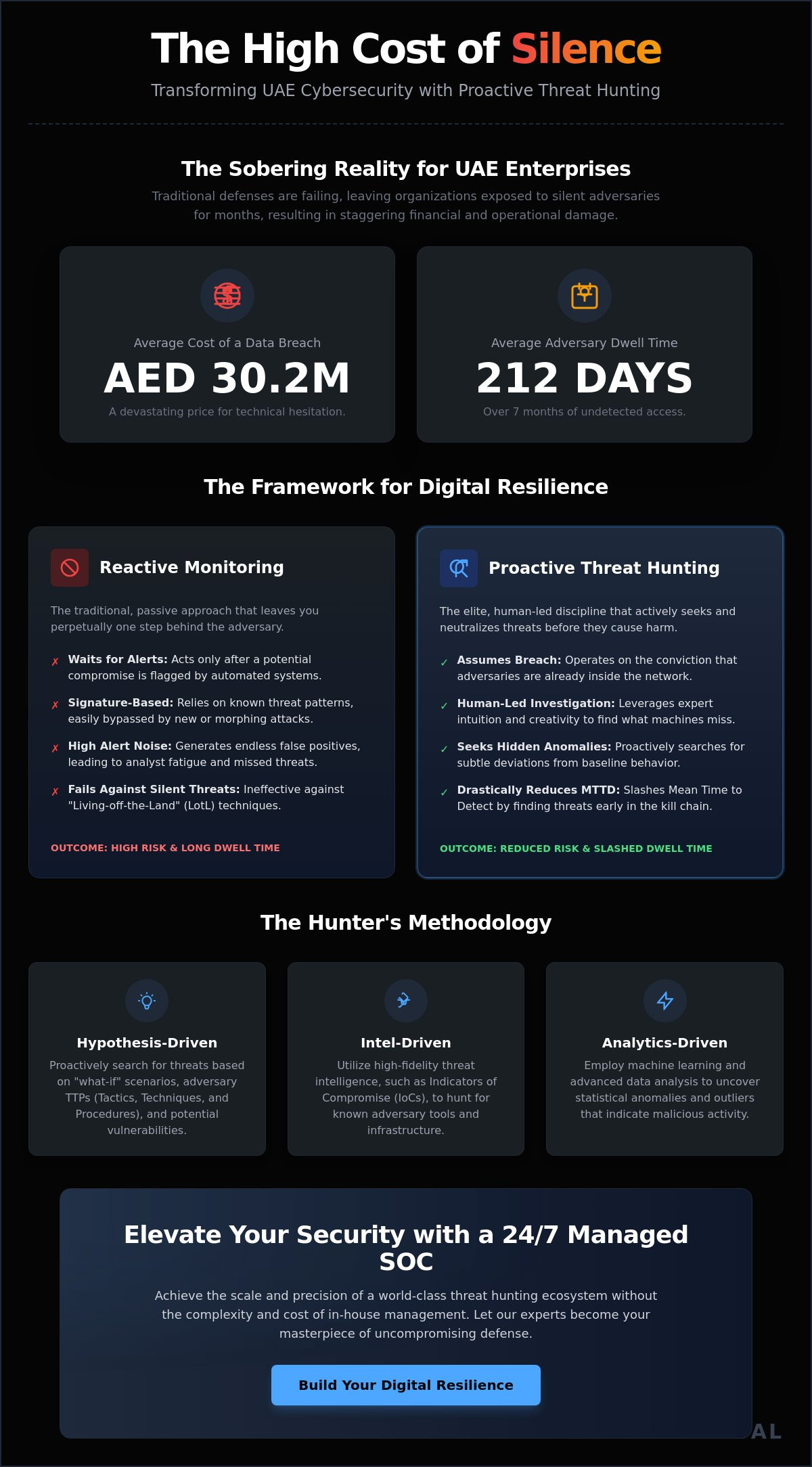
In 2024, the average cost of a data breach for organizations in the United Arab Emirates reached a staggering AED 30.2 million, a figure that highlights the devastating price of technical hesitation. You likely feel the exhaustion of managing automated alerts that create endless noise while sophisticated adversaries remain undetected for an average of 212 days. It's a reality where standard monitoring is no longer a sufficient shield for your digital infrastructure. To achieve true security, you must adopt the discipline of threat hunting, a proactive art form that identifies hidden threats before they can inflict damage. This isn't just about software; it's about engineering a masterpiece of uncompromising defense.
We'll show you how to transform your security posture from a reactive burden into a resilient asset. This guide provides a clear framework for implementing a hunting capability that slashes dwell time and reduces organizational risk within the UAE's unique regulatory landscape. You'll gain a deep understanding of how manual investigations differ from routine monitoring. We'll explore the path to technical superiority, ensuring your security is as precise and powerful as the technology it protects.
Key Takeaways
- Understand why silent adversaries bypass traditional perimeters and how to neutralize the critical "dwell time" that currently leaves UAE networks exposed for months.
- Master the three core models of threat hunting—hypothesis, intel, and analytics—to transform raw telemetry into a proactive, human-led masterpiece of defense.
- Learn to drastically reduce your Mean Time to Detect (MTTD) by transitioning from standard reactive monitoring to a framework of uncompromising digital resilience.
- Explore the blueprint for designing an elite hunting capability that ensures total visibility across your cloud-native and on-premise technological assets.
- Discover how a 24/7 Managed SOC empowers enterprises to achieve the scale and precision of a world-class security ecosystem without the complexity of in-house management.
Beyond the Perimeter: Why Traditional Defenses Fail Against Silent Adversaries
Securing a high-performance digital infrastructure in 2026 requires more than just software. It demands a masterpiece of engineering and a relentless pursuit of technical perfection. Traditional defenses are failing because they're designed for yesterday's predictable threats. Threat hunting is the elite response to this systemic vulnerability. It's a proactive, human-led search for undetected malicious activity that treats every byte of data with professional skepticism. This isn't a mere automated scan; it's a disciplined craft where human intuition and deep technical expertise intersect to find what machines miss.
The reality for enterprises in the UAE is sobering. Despite massive investments in cybersecurity, the concept of "dwell time" remains the most dangerous metric in the boardroom. Industry data confirms that the global average for undetected access still hovers around 200 to 212 days. In the high-stakes financial hubs of Dubai and Abu Dhabi, those seven months of silence can result in damages exceeding 15 million AED per incident. Relying on signature-based detection is a relic of the past. AI-driven attacks now morph their code in real-time, rendering standard antivirus databases obsolete before they're even downloaded. We must move toward foundational Cyber Threat Hunting Methodologies to bridge the gap between automated logs and the sophisticated reality of modern warfare.
Adopting an "Assume Breach" mindset is no longer optional; it's the bedrock of modern digital resilience. We don't wait for a red light on a dashboard to tell us we're under fire. We operate under the conviction that the adversary is already inside the wire, moving quietly and waiting for the perfect moment to strike. This shift in perspective transforms security from a passive cost center into an active, mission-critical hunt for excellence.
The Anatomy of a Silent Breach
Advanced Persistent Threats (APTs) don't use loud, recognizable malware that triggers traditional firewalls. They employ living-off-the-land (LotL) techniques, utilizing legitimate administrative tools like PowerShell or WMI to blend into daily operations. By using the system's own strength against itself, they evade automated alerts with surgical precision. The invisible breach is the primary risk to modern enterprises because it transforms trusted internal processes into weapons of silent data exfiltration.
The Evolution of Defense: From Passive to Active
The "set and forget" mentality of the early 2020s died under the weight of sophisticated supply chain attacks. We've entered an era of human-centric defense where the defender's creativity must outpace the attacker's greed. This proactive stance is the core of a Zero Trust Architecture, where no user or device is granted implicit trust regardless of their location. By integrating active hunting into our daily rhythm, we ensure that security is never a static barrier but a dynamic, uncompromising pursuit of safety. Every project is a personal mission to ensure that the technology we build remains an untouchable sanctuary for our clients' most valuable assets.
The Methodology of the Masterpiece: How Professional Threat Hunting Operates
Effective threat hunting isn't a sequence of automated scripts; it's a disciplined craft that demands an artisan’s precision. It begins with the aggregation of massive data telemetry. We don't just look at surface-level alerts. We ingest every log from endpoints, network traffic, and cloud environments to build a comprehensive digital canvas. This visibility is the foundation of the hunt. Without it, the hunter is blind. The Cybersecurity and Infrastructure Security Agency defines Proactive Threat Hunting as a critical layer for identifying malicious activity that evades existing security controls, and we treat this mission as a personal engineering challenge.
The hunter is the soul of this operation. While machine learning identifies anomalies, human intuition remains the ultimate security tool. Algorithms can't yet replicate the "gut feeling" of a veteran analyst who recognizes the subtle deviations in a system's pulse. To guide this intuition, hunters utilize the MITRE ATT&CK framework. This global knowledge base allows us to map adversary behavior against known tactics and techniques. In the UAE, where the average cost of a data breach reached 29.6 million AED in 2023, this level of forensic detail isn't a luxury; it's a necessity for survival.
The Hypothesis-Driven Approach
This model starts with a "What if?" scenario. We don't wait for a siren to wail. Instead, we ask questions based on 2026 industry trends, such as: "What if an attacker is utilizing AI-generated lateral movement scripts to bypass our current detection baseline?" We then test this hypothesis against real-world environmental data. We iterate the process, filtering out the noise to find the "needles in the haystack." It's a relentless pursuit of perfection where we refine our queries until the truth emerges from the data.
Leveraging Global Threat Intelligence
Intel-driven hunting integrates Indicators of Compromise (IoCs) and Indicators of Attack (IoAs) from across the globe. We don't operate in a vacuum. By analyzing the latest telemetry from international breaches, we preemptively secure local ecosystems before the threat reaches our borders. Zurix's sophisticated infrastructure enables a continuous feedback loop. Every discovery made during a hunt is instantly converted into a permanent, automated detection. This ensures that once a masterpiece of defense is created, it remains an impenetrable shield for the future.
Our methodology combines three core pillars to ensure no shadow remains unexplored:
- Hypothesis-driven: Formulating theories based on the latest threat actor profiles.
- Intel-driven: Utilizing real-time data feeds to identify known malicious signatures.
- Analytics-driven: Deploying advanced statistical models to spot deviations in normal user behavior.
This trifecta creates a proactive stance that transforms security from a reactive chore into a strategic advantage. It's about total control over the digital environment.
Proactive Hunting vs. Reactive Monitoring: A Framework for Digital Resilience
Reactive monitoring is the baseline of traditional security; it's the digital equivalent of a smoke detector. It functions reliably, but only after the fire has already started. In the high-stakes financial and energy hubs of Dubai and Abu Dhabi, relying solely on alerts is a strategic gamble that most enterprises can't afford. Standard SOC monitoring reacts to known signatures and predefined rules. If an attacker utilizes a novel "living off the land" technique or a zero-day exploit, the alarm remains silent. This creates a catastrophic dwell time where intruders move undetected for weeks.
Threat hunting fundamentally changes this equation. It's an active, hypothesis-driven pursuit that assumes a breach has already occurred. By shifting the focus from waiting to searching, security teams can slash the Mean Time to Detect (MTTD) from a global average of 200+ days to just a few hours. This technical precision minimizes the blast radius, ensuring that a single compromised workstation doesn't escalate into a network-wide blackout. At Zurix, we view this transition not just as a policy change, but as a commitment to uncompromising engineering excellence where every anomaly is a lead to be followed.
The Reactive Trap: Alert Fatigue and Missed Signals
Recent industry data indicates that 45% of security alerts are ignored by overwhelmed analysts. This isn't a failure of character; it's a failure of the reactive model. Analysts in high-pressure environments are buried under a mountain of noise, leading to "false negatives" where sophisticated threats bypass automated filters entirely. Reactive models hand the initiative to the adversary. They allow the attacker to choose the time, the method, and the target of the strike while the defense remains in a perpetual state of catch-up.
The Proactive Advantage: Taking the Initiative
Modern threat hunting forces the attacker to be perfect every time, while the hunter only needs to be right once to collapse an entire attack chain. This proactive stance is the cornerstone of a High-Performance Incident Response Plan. It transforms security from a cost center into a value-add by drastically reducing the ROI of the attacker. In the UAE, the average cost of a data breach reached approximately AED 30.2 million in 2023. By identifying threats in the reconnaissance or initial access phase, organizations avoid these staggering costs and maintain their reputation for reliability. It's a masterstroke of risk reduction that justifies every dirham of security spend.
- Reduced MTTD: Detecting intruders before they exfiltrate data.
- Minimized MTTR: Faster response times through pre-identified hunt paths.
- Hardened Infrastructure: Using hunt findings to close architectural gaps permanently.
Designing an Elite Hunting Capability: From Hypothesis to Neutralization
Creating a superior threat hunting operation requires the same precision as hand-assembling a high-performance workstation. It's a structured, five-step discipline that transforms raw data into tactical superiority. In the high-stakes digital landscape of the UAE, where the cost of a data breach can exceed 25 million AED, reactive measures are no longer acceptable. We build defense as a form of engineering excellence.
- Step 1: Data Preparation. You can't defend what you can't see. We ensure absolute visibility across hybrid cloud environments and local UAE data centers. This involves normalizing telemetry from every endpoint to eliminate blind spots, ensuring that on-premise assets and cloud workloads speak the same language.
- Step 2: Hypothesis Generation. Hunters don't wander aimlessly. They develop theories based on specific threats, such as the 38% rise in localized ransomware variants targeting the Dubai financial sector observed in early 2026.
- Step 3: Execution. Using EDR and SIEM tools, hunters query the environment to test their theories. They look for the "silent" indicators, such as subtle lateral movements or unusual API calls, that automated systems often miss.
- Step 4: Investigation. When an anomaly appears, the hunter deep-dives into memory forensics and network artifacts. The goal is to confirm malicious intent and map the attacker's footprint before a breach escalates.
- Step 5: Resolution and Hardening. Neutralization is only the beginning. We purge the threat and immediately reconfigure the perimeter. This ensures that specific vulnerability never exists again, effectively turning a moment of risk into a permanent upgrade.
Essential Tools for the Modern Hunter
The 2026 landscape demands tools that match the speed of the adversary. EDR and XDR platforms serve as the hunter's eyes; meanwhile, AI models sift through petabytes of logs in seconds to identify unauthorized encrypted tunnels. We treat defensive infrastructure as code. This allows us to deploy security patches and configuration changes across a regional network in under 15 minutes. It's a benchmark of precision that defines our commitment to performance.
The Feedback Loop: Hardening the Masterpiece
A successful hunt isn't a one-off event. It's a contribution to a larger architecture of safety. Every discovery informs automated policies, turning a manual catch into a permanent shield. This integration is vital for maintaining ISO 27001 Compliance within the UAE regulatory framework. By aligning threat hunting findings with GRC (Governance, Risk, and Compliance) strategies, we transform technical victories into business resilience. Continuous improvement isn't just a goal; it's the standard for those who refuse to settle for anything less than perfection.
Elevating Your Security Ecosystem with Zurix Global’s Managed SOC
Building an in-house security operations center is a monumental undertaking that remains out of reach for 78 percent of mid-market enterprises in the UAE. The financial commitment is staggering; a fully functional SOC requires an initial investment often exceeding 2,500,000 AED, not including the ongoing costs of talent retention and software licensing. Most organizations find themselves trapped in a cycle of reactive firefighting because they lack the specialized personnel required for sophisticated threat hunting. At Zurix Global, we believe cybersecurity shouldn't be a burden. It's an engineering masterpiece that empowers your growth.
Our 24/7 Managed SOC acts as an extension of your vision. We provide the infrastructure and the intellect needed to outpace modern adversaries. By leveraging cutting-edge technology and a global perspective, we transform security from a cost center into a competitive advantage. We handle the complexity so you can focus on your digital transformation journey across the Middle East. Our approach is defined by hallowed engineering principles where every alert is a signal and every response is a calculated move toward total system integrity.
The Zurix Difference: Expertise Without Compromise
We don't settle for "good enough." Our team consists of elite specialists who navigate the intricate layers of cloud-native architectures and DevOps pipelines with surgical precision. We combine the cold, calculating accuracy of AI with the burning passion of human experts who treat every line of code as a personal mission. This synergy allows us to perform continuous threat hunting to detect anomalies that automated systems miss. We build resilient, scalable IT ecosystems that don't just survive attacks; they thrive under pressure. Our commitment to perfection ensures your digital assets remain untouchable in an increasingly volatile digital landscape.
Your Next Step Toward Absolute Resilience
Security is a binary state: you're either secure, or you're not. Transitioning from a state of "hoping you are safe" to "knowing you are secure" requires a fundamental shift in strategy. This evolution begins with a proactive assessment of your current posture. Our experts analyze your environment to identify hidden vulnerabilities before they become catastrophic failures. This is the moment to claim your peace of mind and protect your legacy.
The path to uncompromising performance is clear. Secure your digital masterpiece with Zurix Global today. Every second of hesitation is a window of opportunity for an intruder. Let's close those windows together with the precision and authority your business deserves.
Securing Your Legacy in the Age of Invisible Adversaries
The era of passive defense has ended, replaced by a landscape where silent adversaries bypass even the most sophisticated automated firewalls. Organizations across the UAE must recognize that true digital resilience in 2026 demands a shift from reactive alerts to continuous, hypothesis-led threat hunting. This methodology transforms security from a simple requirement into a refined engineering discipline. With the UAE’s digital economy projected to contribute significantly to the non-oil GDP by 2031, protecting these assets requires the uncompromising precision of 24/7 expert-led SOC operations. By integrating Zero Trust architectures, businesses can neutralize vulnerabilities before they ever escalate into breaches. Zurix Global treats your digital infrastructure as a masterpiece that requires elite technical mastery and a personal commitment to excellence. Our specialists bring a proven track record in digital transformation, ensuring your cloud environments remain impenetrable against evolving global risks. The pursuit of perfection in cybersecurity isn't a destination but a constant state of evolution. It's time to elevate your defense to a level of professional excellence that matches the scale of your enterprise.
Discover how Zurix Global transforms security into a strategic masterpiece.
Your vision deserves a defense that's as visionary as the technology it protects.
Frequently Asked Questions
What is the difference between threat hunting and penetration testing?
Threat hunting is a proactive, continuous search for undetected threats already inside your network, whereas penetration testing is a scheduled assessment of known vulnerabilities. In the UAE, where cyberattacks rose by 11% in 2023, relying solely on testing leaves dangerous gaps. Hunting assumes a breach has occurred. It's a meticulous craft of seeking out silent adversaries. Penetration testing follows a script to break in; hunting follows a hypothesis to find what's hidden.
Can threat hunting be automated?
Complete automation's impossible because threat hunting requires human intuition and creative hypothesis generation. While 70% of data collection and initial filtering can be handled by AI-driven tools, the final analysis remains a human masterpiece. Automation handles the mundane telemetry. Skilled analysts in Dubai use these tools to focus on the 30% of complex anomalies that algorithms can't decipher. It's a fusion of machine speed and human genius.
What are Indicators of Compromise (IoCs) in threat hunting?
Indicators of Compromise (IoCs) are digital footprints like malicious IP addresses, file hashes, or unusual domain names that signal a security breach. In 2024, the average time to detect a breach in the Middle East was 244 days. Threat hunting uses these IoCs to backtrack through logs and identify historical compromises. They serve as the raw materials for our precision-engineered defense strategies. We don't just react to IoCs; we use them to predict future movements.
How often should an organization perform threat hunting?
Organizations should perform threat hunting continuously to maintain a state of uncompromising security. A 2025 industry report suggests that 62% of high-performing SOCs in the UAE conduct daily hunts. Monthly or quarterly assessments aren't sufficient against modern adversaries. Constant vigilance ensures that your digital infrastructure remains a fortress. Every hour of delay increases the potential for data exfiltration. Continuous hunting is the only path to true technical excellence.
Do I need a special team for threat hunting?
You need a dedicated team of elite analysts who possess a deep understanding of the local threat landscape in the UAE. While general IT staff handle maintenance, hunters are specialized artisans of security. 45% of UAE firms now outsource this to managed providers due to the scarcity of top-tier talent. This isn't a part-time task. It requires a visionary mindset and a commitment to perfection that standard IT roles don't provide.
How does threat hunting improve my overall GRC posture?
Threat hunting strengthens GRC by providing empirical evidence of control effectiveness and compliance with UAE NESA standards. It transforms abstract risk management into a measurable, technical reality. By identifying 15% more hidden vulnerabilities than standard audits, hunting proves your commitment to data sovereignty. It ensures your Governance, Risk, and Compliance framework isn't just a document. It becomes a living, breathing shield of uncompromising integrity.
What is the first step to starting a threat hunting program?
The first step is establishing a comprehensive data collection foundation that covers 100% of your critical assets. You can't hunt what you can't see. Begin by aligning your strategy with the UAE's Cyber Security Strategy 2021-2025 to ensure regulatory harmony. Once your telemetry is precise, formulate your first hypothesis based on high-risk scenarios. This initial preparation is the architectural blueprint for your entire security masterpiece.
Is threat hunting only for large enterprises?
Threat hunting is essential for any organization, regardless of size, that handles sensitive data or critical infrastructure in the UAE. Small and medium enterprises (SMEs) accounted for 40% of targeted attacks in the region during 2024. While the scale differs, the need for precision remains. You don't need a massive budget to start. You need a commitment to uncompromising performance and a strategic approach to protecting your unique digital assets.