

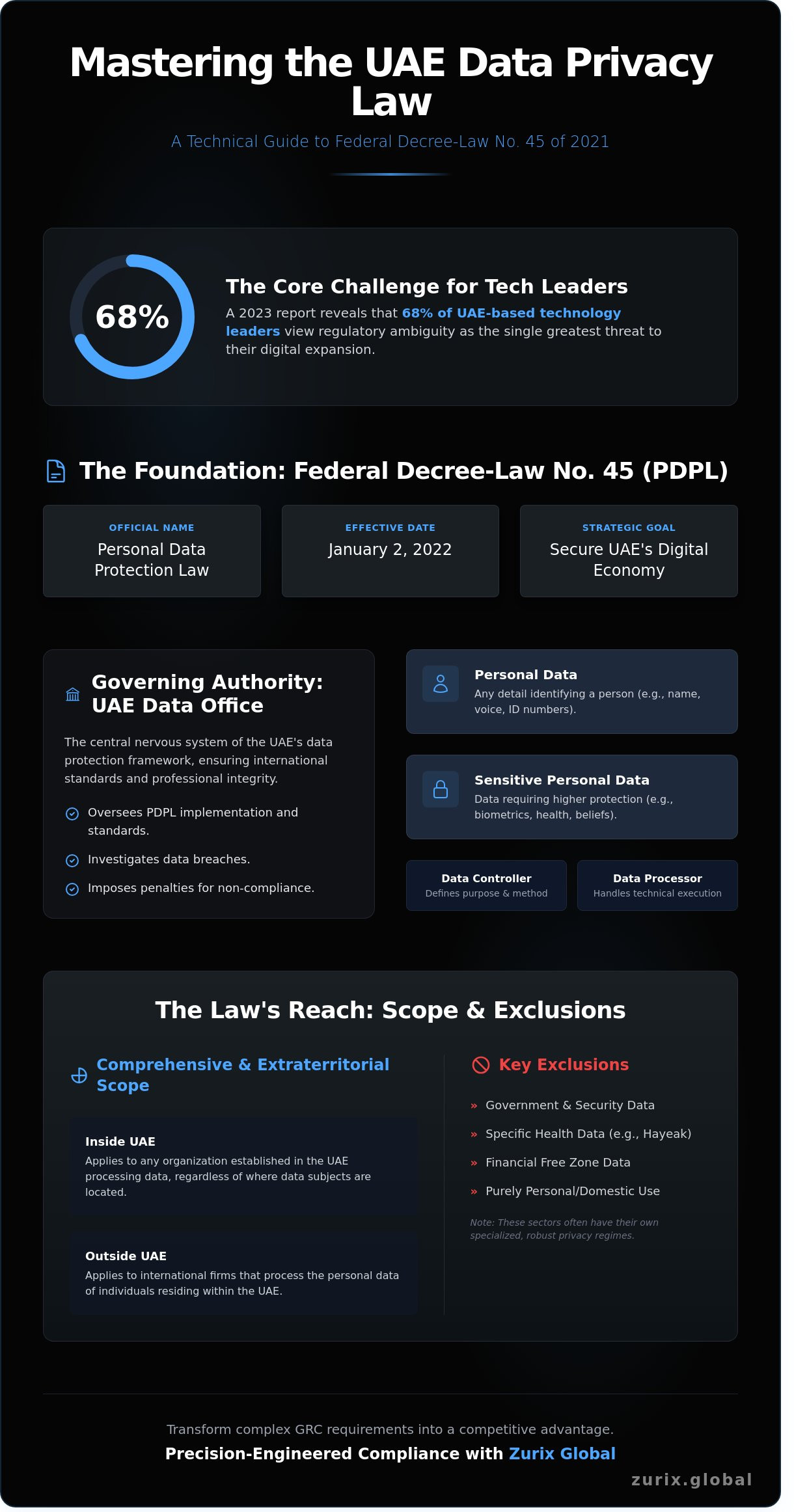
A 2023 industry report highlighted that 68% of UAE-based technology leaders view regulatory ambiguity as the single greatest threat to their digital expansion. You've likely realized that safeguarding personal information is a moral imperative, but the complexity of mapping legal mandates to your specific cloud architecture often feels like an insurmountable engineering challenge. The fear of heavy penalties under the executive regulations shouldn't stifle your innovation or compromise your technical vision.
This guide empowers you to master the nuances of the uae data privacy law, transforming Federal Decree-Law No. 45 of 2021 from a source of anxiety into a cornerstone of your organization's digital resilience. We'll provide a precise roadmap for technical implementation and a clear strategy for data sovereignty that meets the highest engineering standards. You're about to discover how to align your digital assets with the PDPL to ensure your data architecture remains an uncompromising masterpiece of security and trust.
Key Takeaways
- Decipher the strategic architecture of Federal Decree-Law No. 45 to align your operations with the UAE’s vision for a secure, world-class digital economy.
- Master the core principles of transparency and purpose limitation to ensure your application of the uae data privacy law is both legally precise and ethically sound.
- Bridge the gap between legal theory and technical reality by implementing data sovereignty measures that provide uncompromising protection beyond simple paperwork.
- Elevate your deployment strategy by integrating Privacy by Design and Infrastructure as Code (IaC) to automate compliance within your cloud and DevOps ecosystems.
- Transform complex GRC requirements into a competitive advantage with a precision-engineered roadmap that moves your business from initial gap analysis to full-scale digital resilience.
Understanding UAE Federal Decree-Law No. 45: The New Era of Privacy
The UAE entered a new era of digital governance on January 2, 2022, when Federal Decree-Law No. 45 of 2021 officially came into effect. This legislative masterpiece, known as the Personal Data Protection Law (PDPL), represents a foundational pillar of the "Projects of the 50" initiative. It's not just a regulatory hurdle; it's a strategic blueprint designed to cement the UAE's position as a global digital sanctuary. By establishing a rigorous framework for the uae data privacy law, the government ensures that innovation and security exist in a state of perfect equilibrium. Every provision reflects a commitment to excellence that mirrors the engineering precision found at Zurix Global.
The UAE Data Office acts as the central nervous system of this framework. Established under Decree-Law No. 44 of 2021, this authority oversees the implementation of standards that mirror the highest international benchmarks. It ensures that every byte of information is treated with absolute professional integrity. The office holds the power to issue executive regulations, investigate breaches, and impose penalties, creating a landscape where trust is the primary currency.
Defining Personal and Sensitive Data
Precision is paramount when classifying information under the federal framework. Personal Data encompasses any detail that identifies a natural person, such as names, voice recordings, or identification numbers. Sensitive Personal Data requires an even higher level of protection. This category includes biometric data, health records, and religious beliefs. The law distinguishes between the Data Controller, who defines the purpose and method of processing, and the Data Processor, who handles the technical execution. This clarity is essential for establishing accountability in complex digital ecosystems.
Territorial and Material Scope
The reach of the uae data privacy law is both comprehensive and uncompromising. It applies to any organization established within the UAE that processes data for subjects inside or outside the country. It also features a bold extraterritorial reach. International firms located abroad must comply if they process the personal data of individuals residing within the Emirates. This aligns with the technical concept of data sovereignty, ensuring that UAE residents enjoy protection regardless of where a server physically resides.
However, the law respects existing specialized frameworks to avoid technical redundancy. It excludes certain sectors:
- Government data used for public interest or national security.
- Health data governed by specific sector legislation like the "Hayeak" system.
- Financial data processed within specialized financial free zones, which maintain their own world-class privacy regimes.
- Personal data used for purely domestic or non-professional purposes.
Core Provisions and Individual Rights Under the PDPL
Federal Decree-Law No. 45 of 2021 represents a masterclass in regulatory engineering. This legislation, commonly known as the uae data privacy law, isn't a mere set of suggestions; it's a rigorous framework designed to protect the digital integrity of every resident. At its heart lie three non-negotiable principles: transparency, security, and purpose limitation. Organizations can no longer treat data as a limitless resource. Every byte processed must have a defined, legitimate purpose. You must ensure that the technical architecture of your systems reflects a "security by design" philosophy, treating data protection as a core engineering challenge rather than an afterthought.
While consent is the primary pillar for processing, it's not the only one. The law recognizes that operational reality requires flexibility. Article 4 outlines specific instances where processing is permitted without explicit consent, such as the fulfillment of legal obligations or the protection of public interest. However, for companies managing large-scale personal data, the requirements are uncompromising. You must implement mandatory controls that include detailed logs of processing activities and impact assessments. Cross-border data transfers are strictly regulated; data can only leave the UAE if the destination country provides an adequate level of protection or if specific, approved contractual clauses are in place. Implementing practical steps for PDPL compliance is the only way to ensure your international operations remain uninterrupted and legally sound.
The Rights of the Data Subject
The PDPL shifts the power dynamic back to the individual. Data subjects now possess the right to demand full transparency regarding what information your business holds. They can request data portability, allowing them to transfer their personal information between service providers in a structured, machine-readable format. Perhaps most significantly, the "right to be forgotten" allows individuals to demand the total erasure of their data once the original purpose for collection is met. Your systems must be capable of executing these requests with surgical precision to avoid the heavy penalties associated with non-compliance. Precise data management is the hallmark of a professional digital operation.
The Data Protection Officer (DPO) Requirement
Appointing a Data Protection Officer is a mandatory requirement for businesses engaged in high-risk processing or large-scale systematic monitoring. This isn't just a checkbox exercise. The DPO acts as the visionary architect of your privacy strategy, ensuring that every internal process aligns with the uae data privacy law. They serve as the official liaison with the UAE Data Office and oversee the constant auditing of your technical safeguards. Many elite organizations choose to outsource this function. Engaging expert GRC consulting allows you to leverage specialized knowledge without the overhead of a full-time executive hire. It's a strategic move that ensures your compliance framework is a technological masterpiece of reliability and performance.
Beyond Legal Paperwork: The Technical Reality of Data Sovereignty
A signed privacy policy is merely a blueprint; it isn't a fortress. Many organizations fall into the trap of believing that legal documentation equates to security. This misconception creates a dangerous vulnerability. Under the uae data privacy law, specifically Federal Decree-Law No. 45 of 2021, compliance is an engineering challenge, not just a clerical one. While the UAE PDPL shares DNA with the GDPR, international firms must recognize critical nuances. The UAE framework places a heavier emphasis on the role of the UAE Data Office and specific local consent requirements that can differ from European standards. True data sovereignty requires more than just knowing where data sits. It demands a masterpiece of technical architecture that ensures data remains under UAE jurisdiction when required.
The pursuit of excellence leads many visionary firms toward ISO 27001 compliance in the UAE. This international standard provides the uncompromising structure needed to support legal mandates. When we discuss data sovereignty in the cloud, we're talking about precision. With AWS and Microsoft Azure now operating local regions in the UAE, businesses have no excuse for data latency or jurisdictional ambiguity. Storing sensitive information within the borders of the Emirates isn't just a preference; for certain sectors, it's a non-negotiable requirement for peak performance and legal safety.
Bridging the Gap Between Legal and IT
Compliance fails when the legal team doesn't speak the language of the server room. Technical security controls must map directly to legal articles. This starts with automated data discovery. You can't protect what you can't see. Identifying personal identifiable information (PII) across the entire tech stack allows for precise classification. We don't settle for "adequate" protection. We build a culture of privacy where developers and engineers treat data as a high-value asset, ensuring that privacy by design isn't just a buzzword, but a functional reality of the code itself.
Risk Management and Impact Assessments
High-risk processing activities require a Data Protection Impact Assessment (DPIA). This isn't a box-ticking exercise. It's a rigorous diagnostic process to identify vulnerabilities before they manifest as breaches. To validate these mechanisms, elite firms employ Vulnerability Assessment and Penetration Testing (VAPT). This proactive combat stance ensures that your defense systems are battle-tested. In the UAE market, where the cost of a data breach can reach millions of AED, these assessments are the difference between a secure legacy and a catastrophic failure. We treat every DPIA as a mission-critical audit, ensuring that the uae data privacy law is upheld through uncompromising technical verification.
Strategic Implementation: Privacy by Design in Cloud and DevOps
Privacy isn't a secondary layer; it's the structural foundation of high-performance engineering. To meet the rigorous standards of the uae data privacy law, organizations must embed protection into the very code that builds their environments. We don't just deploy applications; we architect digital fortresses. Integrating privacy controls directly into the CI/CD pipeline ensures that every build meets compliance before it ever touches a production server. This is the technical superiority required in a market where data is the most valuable asset. Every line of code must reflect a commitment to the user's digital sovereignty.
Infrastructure as Code (IaC) serves as the primary enforcement mechanism for data residency. By defining geographic constraints within Terraform or CloudFormation scripts, engineers programmatically prevent data from leaving UAE borders. This eliminates human error. It guarantees that sensitive information remains within the sovereign jurisdiction of the Emirates, exactly where the law demands it stay. Strict alignment with the uae data privacy law ensures that Zero Trust Architecture isn't just a buzzword but a functional reality. For containerized environments like Kubernetes, this means implementing pod security policies and network isolation that treat every microservice as a potential risk point. Trust is never given; it's cryptographically earned.
Automating Compliance with DevOps
Shift-left security moves privacy testing to the earliest stages of development. We use automated data masking to ensure that developers never interact with live, identifiable information in testing environments. This protects the integrity of the individual's rights while maintaining development speed. Every action creates an immutable trail. These logs aren't just data points; they're the evidence required by the UAE Data Office to prove continuous compliance. Precision in auditing is what separates a masterpiece from a liability.
Cloud Governance and Residency
Navigating cloud architecture for local data storage requires more than just picking a region. It demands a deep understanding of how Identity and Access Management (IAM) prevents unauthorized exposure. In the UAE, encryption at rest and in transit are the technical pillars that cannot be compromised. We implement 256-bit AES encryption as a baseline, ensuring that even if physical hardware is accessed, the data remains an indecipherable cipher. It's about engineering peace of mind through technical perfection and uncompromising standards.
Your infrastructure should be a testament to your commitment to security. Secure your digital future with Zurix engineering.
Navigating GRC Complexity with Zurix Global
Compliance with the uae data privacy law demands more than a checklist; it requires a precision-engineered architecture that balances ironclad security with fluid business performance. At Zurix Global, we don't view Governance, Risk, and Compliance (GRC) as a series of hurdles. We treat it as a technical masterpiece, where every policy and control is a deliberate stroke of engineering excellence. Our approach begins with a surgical gap analysis, identifying every vulnerability in your current infrastructure before we architect a roadmap that leads to total regulatory alignment.
We've designed our implementation process to be seamless and uncompromising. We don't just hand you a manual; we build the engine. From the initial audit to the final deployment of privacy controls, our team ensures your organization meets the strict requirements of Federal Decree-Law No. 45 of 2021. This isn't about mere survival. It's about building a foundation of trust that allows your business to scale within the UAE’s sophisticated digital economy without fear of legal or reputational fallout.
Our Managed GRC and Security Services
The threat landscape never sleeps, and neither does our defense. We provide continuous compliance monitoring specifically optimized for M365 and complex cloud ecosystems. Our experts don't rely on automated scripts alone. We conduct expert-led Vulnerability Assessment and Penetration Testing (VAPT) to probe your defenses with the same intensity as a real-world adversary. This proactive stance ensures that the uae data privacy law standards are maintained 24/7, not just during audit season.
- Cloud Ecosystem Monitoring: Real-time oversight of data flows within Microsoft 365 and Azure to prevent unauthorized exfiltration.
- Advanced VAPT: Deep-tier testing that identifies logic flaws and configuration errors before they're exploited.
- Incident Response Planning: We develop high-fidelity playbooks that dictate exactly what happens when a breach occurs, minimizing downtime and meeting the 72-hour notification windows required by regulators.
The Zurix Promise: Uncompromising Excellence
UAE leaders choose Zurix Global because we refuse to accept "good enough." We understand that your data is your most valuable asset, and protecting it is a personal mission for our engineers. We don't offer off-the-shelf products; we provide bespoke security art that empowers your digital transformation. By fusing high-performance hardware with elite-level software governance, we create environments where privacy and performance coexist perfectly. Your digital future deserves nothing less than a masterpiece of security. Secure your digital future with Zurix Global today and experience the peak of technological resilience.
Forge a Legacy of Digital Trust and Sovereign Security
Federal Decree-Law No. 45 isn't a mere administrative hurdle; it's a definitive mandate for technological mastery within the Emirates. Since the uae data privacy law became effective on January 2, 2022, the standard for excellence has shifted from reactive paperwork to proactive, zero-trust engineering. True compliance demands a fusion of legal precision and high-performance architecture where data sovereignty is woven into every line of code. We believe that security is a form of technological art. Our specialists provide 24/7 Managed Security Operations Center oversight and deep expertise in NESA compliance to transform your GRC obligations into a competitive advantage. Zurix Global approaches every project as a personal mission to achieve uncompromising performance. We don't settle for "good enough" when your digital reputation is on the line. It's time to elevate your infrastructure beyond the reach of vulnerability. Architect your compliant IT ecosystem with Zurix Global. Your vision deserves a foundation that's as resilient and ambitious as the future you're building.
Essential Insights into UAE Data Privacy Compliance
What is the main UAE data privacy law currently in effect?
Federal Decree-Law No. 45 of 2021 is the primary legislation governing personal data protection in the UAE. This landmark law took effect on January 2, 2022, establishing a comprehensive framework for how organizations handle sensitive information. It mirrors international standards while maintaining a focus on the unique digital landscape of the Emirates. Every business must align its technical architecture with these mandates to ensure uncompromising security.
Does the UAE PDPL apply to companies located outside the UAE?
The UAE PDPL applies to any company processing the personal data of UAE residents, regardless of the organization's physical location. This extraterritorial reach ensures that global entities interacting with the UAE market adhere to the same precision and standards as local firms. If your international operations touch the digital footprint of individuals within the Emirates, compliance isn't optional. It's a fundamental requirement of your technological ecosystem.
What are the penalties for non-compliance with the UAE data privacy law?
Non-compliance with the uae data privacy law can lead to administrative fines and penalties determined by the UAE Data Office. While specific financial brackets are detailed in the Executive Regulations, authorities have the power to impose significant sanctions for security failures. Protecting data isn't just a legal hurdle; it's a commitment to excellence that prevents costly disruptions and preserves the integrity of your digital assets.
Is consent always required to process personal data in the UAE?
Consent isn't the only legal basis for processing personal data, though it remains a primary pillar of the law. Organizations can process information without explicit consent when it's necessary for contract performance, legal obligations, or protecting public interest. Every data processing activity must be mapped with surgical precision to ensure it falls under a valid legal justification. This clarity is essential for a high-performance compliance strategy.
How does the UAE PDPL differ from the GDPR?
A key difference is that the UAE PDPL lacks the broad legitimate interests processing ground found in the GDPR. The UAE framework requires more specific justifications for data handling. Additionally, the UAE law was enacted on September 20, 2021, and its structure is tailored to the specific regulatory environment of the Middle East. Understanding these nuances is critical for businesses that demand a masterfully designed global privacy program.
What should a business do in the event of a data breach under UAE law?
Businesses must report data breaches to the UAE Data Office and affected individuals if the incident compromises privacy or security. The notification must include specific details about the nature of the breach and the measures taken to mitigate risks. Rapid response is vital. A well-engineered incident response plan acts as a shield, ensuring that even under pressure, your organization maintains its reputation for reliability and technical superiority.
When must a company appoint a Data Protection Officer (DPO) in the UAE?
A company must appoint a Data Protection Officer when its core activities involve high-risk processing or large-scale systematic monitoring of sensitive data. This role is a cornerstone of a secure infrastructure, acting as a visionary guide for privacy compliance. The DPO ensures that every piece of hardware and software operates within the bounds of the law. They bridge the gap between complex engineering and regulatory requirements.
How does the UAE Data Office regulate personal data protection?
The UAE Data Office acts as the central regulator, established under Decree-Law No. 44 of 2021 to oversee the protection of personal data. They're responsible for issuing executive regulations, investigating complaints, and ensuring that the uae data privacy law is applied with absolute consistency. Their role is to foster a digital environment where innovation and privacy coexist in perfect harmony. They set the benchmark for excellence in data governance.