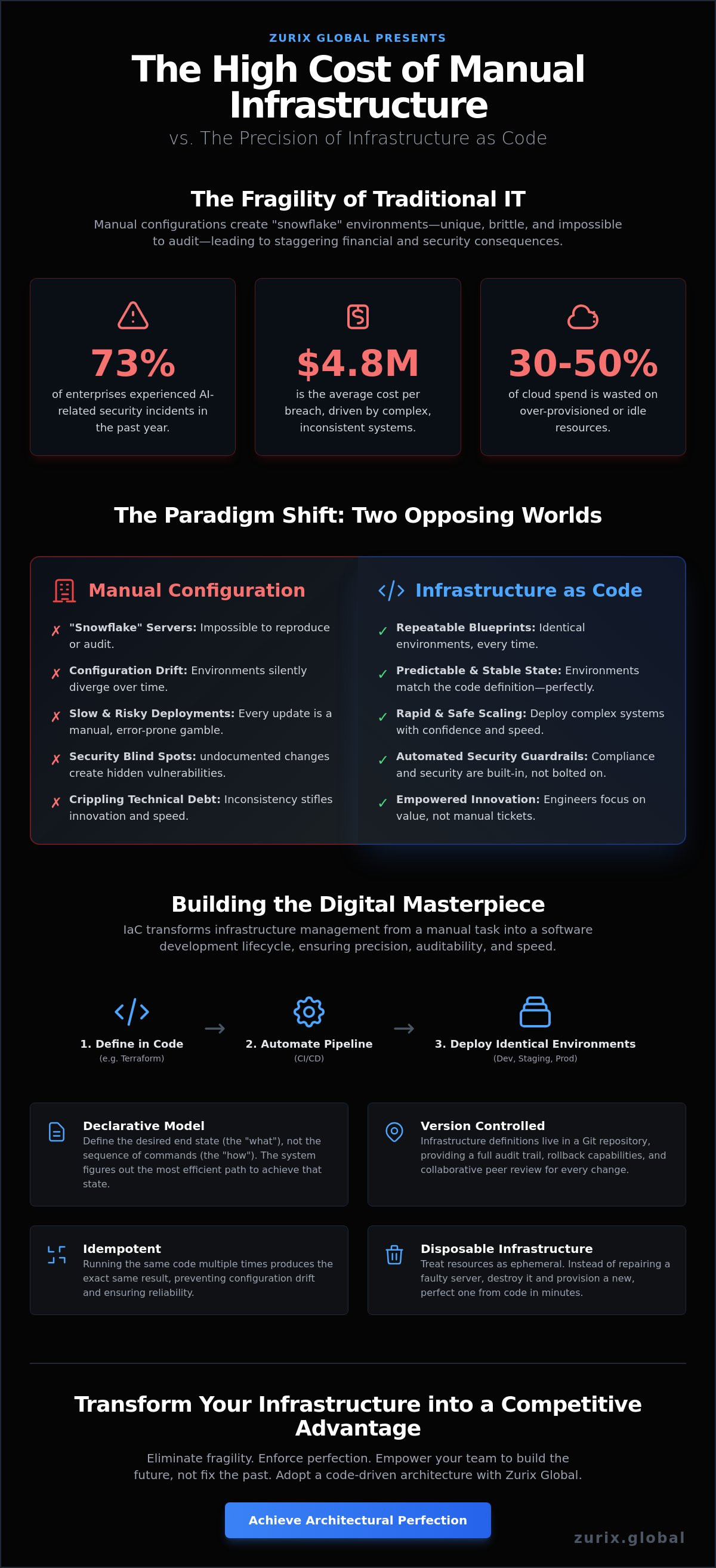
With 73% of enterprises experiencing AI-related security incidents in the past year, costing an average of $4.8 million per breach, can your business really afford the fragility of manual configuration? Most organizations waste between 30% and 50% of their cloud spend on over-provisioned resources while struggling with "snowflake" environments that defy auditing. You've likely felt the stagnation of slow deployment cycles and the anxiety of configuration drift. We understand that in a high-stakes digital ecosystem, the good is never enough; only the perfect is acceptable.
This article empowers you to master the principles of infrastructure as code to eliminate manual errors, ensure uncompromising security, and scale your digital architecture with surgical precision. It's time to treat your environments as a visionary architectural masterpiece rather than a collection of manual tickets. We'll explore how to leverage the latest stable releases, such as Terraform 1.15.0 and OpenTofu 1.11.6, to build repeatable environments and automated compliance guardrails that transform your IT into a secure, high-performance asset.
Key Takeaways
- Identify the hidden costs of "snowflake" environments and learn how to eliminate the technical debt caused by inconsistent manual configurations.
- Explore the transition from physical asset management to software-defined services that treat your digital landscape as a visionary architectural masterpiece.
- Achieve absolute predictability by utilizing the declarative models of infrastructure as code to ensure every environment reaches its intended state with mathematical certainty.
- Integrate rigorous security guardrails and automated compliance protocols to maintain uncompromising standards like ISO 27001 without sacrificing deployment speed.
- Harness infrastructure automation as a strategic asset that empowers your engineering team to focus on high-value innovation rather than manual ticketing.
The End of the 'Snowflake' Server: Why Manual Infrastructure Fails
The traditional approach to IT management often results in what engineers call "snowflake" servers. These are unique, manually-configured environments that, while functional at first, become impossible to reproduce. Every manual update, every hotfix applied through a GUI, and every undocumented change adds to a growing mountain of technical debt. This lack of discipline creates a digital ecosystem where no two servers are truly identical. In a world where Infrastructure as Code (IaC) is the gold standard for excellence, these manual artifacts are liabilities. They slow down innovation and introduce risks that no visionary enterprise should accept.
The Fragility of Traditional IT Ecosystems
Manual changes are the enemies of auditability. When an administrator "points and clicks" their way through a cloud console, they leave behind a trail that's nearly impossible to trace at scale. This leads to the "fear of the reboot," a pervasive anxiety where teams avoid restarting systems because they aren't certain the environment will return to its desired state. Contrast this with the precision of automated pipelines. A masterfully designed pipeline ensures that every component is deployed with surgical accuracy. There's no room for guesswork. Precision is the foundation of performance.
The Business Impact of Infrastructure Inconsistency
The financial consequences of manual mismanagement are staggering. Statistics from May 2026 show that organizations waste an estimated 30% to 50% of their cloud spend on unused or over-provisioned resources. These aren't just numbers; they represent lost opportunities and inefficient architecture. Beyond the wasted budget, inconsistency creates security blind spots. With 73% of enterprises experiencing AI-related security incidents in the past year, costing an average of $4.8 million per breach, the stakes have never been higher. A single misconfiguration in a manually managed environment can open a door that stays hidden until it's too late.
Environment drift is the silent killer of scalability.
When your production environment no longer matches your staging area, every deployment becomes a gamble. This inconsistency forces engineers into a cycle of manual ticketing and reactive firefighting. It stifles the creative energy required for true digital transformation. Implementing a robust infrastructure as code strategy eliminates these bottlenecks. At Zurix, we believe that technology should be an instrument of expression and efficiency. Relying on manual processes is a compromise. True resilience requires the uncompromising discipline of code-driven architecture.
What is Infrastructure as Code? Defining the Digital Masterpiece
Infrastructure as code is the management of IT infrastructure through machine-readable definition files, effectively transforming hardware from a rigid physical asset into a fluid, software-defined service. This evolution allows architects to treat their digital ecosystem as a living masterpiece where every change is tracked, audited, and refined through version control systems like Git. By capturing the entire environment in code, organizations move beyond the fragility of manual intervention into a realm of absolute precision. This methodology serves as the essential cornerstone for any sophisticated cloud architecture, providing the stability required for high-stakes digital operations.
The Evolution from Scripts to Systems
Simple automation scripts often focus on the "how"—a series of steps to reach a goal. In contrast, modern infrastructure as code frameworks focus on the "what," utilizing declarative vs. imperative approaches to define the final desired state. This requires a profound shift in mindset from traditional sysadmin duties to the role of a systems architect. In this new paradigm, infrastructure becomes disposable. If a server fails or drifts from its blueprint, you don't repair it; you destroy it and recreate it from the code with surgical accuracy. This ensures that your production environment remains a pure reflection of your design, free from the corruption of time or human error.
Key Components of an IaC Ecosystem
At the heart of this technological workshop lies the Source of Truth. The code repository is the only valid configuration, rendering manual "out-of-band" changes obsolete. Provisioning engines, such as Terraform (which reached version 1.15.0 on April 29, 2026) or its open-source counterpart OpenTofu (stable version 1.11.6 as of April 8, 2026), act as the master builders that translate these blueprints into reality. These tools work in tandem with container orchestration platforms like Kubernetes to manage complex, distributed systems at scale. When your infrastructure is defined by code, you achieve a level of consistency that manual processes simply cannot replicate. If you're ready to elevate your digital ecosystem to this level of mastery, exploring the bespoke solutions at Zurix is the first step toward uncompromising performance.
Core Mechanisms of IaC: Declarative Models and Idempotence
Precision is not an accident. It's the result of a meticulously crafted logic that dictates exactly how every server, load balancer, and security group should exist within your digital ecosystem. While traditional scripting focuses on a sequence of commands, infrastructure as code utilizes sophisticated mechanisms that provide mathematical certainty to IT operations. By moving away from manual "how-to" instructions and embracing architectural blueprints, enterprises achieve a level of stability that was once considered impossible. This transition is essential for those who view their technology not just as a tool, but as a masterpiece of engineering.
The Declarative Advantage
The declarative model allows architects to define the desired end state of the environment without worrying about the underlying steps to get there. You simply describe the "what," and the provisioning engine handles the "how." This approach drastically reduces the cognitive load on engineering teams, as they no longer need to manage complex, branching logic for every possible failure scenario. The strategic advantages of IaC become clear when you realize that your network topologies and security layers are defined with surgical clarity. Idempotence is the mathematical guarantee that your infrastructure remains in its intended state, no matter how many times the code is executed.
Achieving Immutable Performance
In a high-performance environment, "patching" a running server is a compromise that invites inconsistency and risk. Immutable infrastructure changes this paradigm by ensuring that components are never modified once they're deployed. If a change is required, the existing resource is destroyed and replaced with a fresh, perfect version generated from the code. This practice eliminates configuration drift and ensures that your production environment is always a pure reflection of your design. It streamlines disaster recovery, as rebuilding an entire data center becomes a repeatable process rather than a frantic rescue mission. Such uncompromising discipline is what separates standard IT from a resilient, visionary enterprise.
Beyond automation, these mechanisms create self-documenting systems where the code itself serves as the ultimate technical manual. Anyone with access to the repository can understand the entire architecture's history and current state without digging through outdated wikis or manual logs. This transparency is vital for maintaining security and compliance at scale. If you're ready to transform your infrastructure into a reliable, high-performance asset, the experts at Zurix provide the bespoke guidance needed to master these complex systems. By treating every line of code as a commitment to excellence, you ensure that your digital foundation is as enduring as the vision behind it.
Secure IaC: Bridging the Gap Between Automation and GRC
Security is often treated as a final hurdle, a friction-filled checkpoint that slows down the creative process. This is a fundamental error. In a landscape where security incidents cost an average of $4.8 million per breach, protection must be woven into the very fabric of the architecture. By integrating security guardrails directly into the infrastructure as code definition files, enterprises shift from reactive defense to proactive engineering. This is the essence of DevSecOps. Security is no longer a separate layer; it's an inherent quality of the digital masterpiece.
Maintaining ISO 27001 compliance becomes a repeatable process rather than an annual crisis when your infrastructure is software-defined. Policy as Code (PaC) allows architects to enforce organizational standards, such as NIST Cybersecurity Framework controls or PCI DSS requirements, before a single resource is even provisioned. For organizations operating within the UAE, this automation is critical for meeting stringent NESA requirements. It transforms compliance from a manual checklist into an auditable, automated reality that leaves no room for human error.
Infrastructure as an Audit Trail
Every line of code committed to a repository creates a permanent, transparent record. Git history provides the ultimate audit trail, detailing exactly who changed what and why. This transparency simplifies GRC certifications by allowing auditors to analyze code rather than hunting through screenshots. It also enables the enforcement of Zero Trust principles across the entire ecosystem. Every connection and permission is explicitly defined and verified. There's no ambiguity when the source of truth is code.
Pre-Deployment Security Scanning
The most effective way to handle a vulnerability is to prevent it from ever existing in production. Pre-deployment scanning tools analyze templates for misconfigurations, such as open storage buckets or overly permissive access roles, before they reach the cloud. This reduction of the attack surface is a strategic imperative for building resilient business platforms. Precision in code-defined access controls ensures that your infrastructure is as secure as it is performant. If you seek to build a digital fortress that balances agility with uncompromising protection, the bespoke engineering services at Zurix will elevate your security posture to an art form.
Strategic Implementation: Transforming Infrastructure into a Competitive Advantage
Adopting infrastructure as code is far more than a technical upgrade; it's a profound strategic pivot that redefines the relationship between an enterprise and its digital foundation. Many organizations falter because they treat automation as a mere utility rather than a visionary architectural masterpiece. True success requires a cultural evolution where infrastructure is managed with the same rigor, creativity, and versioned precision as application code. By removing the soul-crushing burden of manual ticketing and reactive firefighting, you empower your engineering elite to focus on value-driven projects that accelerate time-to-market. This shift transforms IT from a cost center into a high-performance engine of innovation.
The transition to a code-defined future is not just about efficiency. It's about survival in an era of unprecedented scale. Organizations that master these principles can effectively manage complex multi-cloud and hybrid environments that would be impossible to maintain manually. This level of control allows for a 30% to 50% reduction in wasted cloud spend by ensuring resources are only provisioned when necessary and with exact specifications. Precision is the ultimate form of economy. When every component of your ecosystem is defined by code, you achieve a level of operational excellence that becomes a formidable barrier to entry for competitors.
Planning Your IaC Roadmap
The journey toward architectural perfection begins by identifying high-impact areas where automation yields immediate resilience. You don't need to overhaul an entire legacy ecosystem in a single day. Instead, establish a Center of Excellence for DevOps to cultivate internal expertise and standardize deployment patterns across the organization. This roadmap must include rigorous training and a commitment to "shifting left," where security and compliance are integrated at the earliest stages of design. Expert-led support is vital during this transition. Complex digital transformations often encounter architectural hurdles that require a visionary perspective to overcome without compromising performance or security.
Zurix Global: Your Partner in Digital Artistry
At Zurix Global, we don't just provide tools; we treat every project as a personal mission and a unique engineering challenge. We believe that the fusion of high-performance hardware and elegant software-defined architecture creates a competitive advantage that cannot be replicated by standard solutions. Our approach combines hued-preciseness with an uncompromising commitment to your specific business vision. We handle the complexities of 24/7 monitoring and automated security guardrails so your team can pursue perfection in their own creative fields. We design automated digital masterpieces that are built to endure.
The path forward is clear for leaders who refuse to settle for the status quo. Moving toward a secure, code-defined future is the only way to ensure your digital foundation remains as resilient as your business ambitions. It's time to replace manual toil with the surgical precision of automated architecture. Elevate your infrastructure with Zurix Globals expert DevOps & Automation services.
Forge Your Legacy with Code-Defined Precision
The transition from fragile manual configurations to a resilient, software-defined ecosystem is no longer optional for those seeking the pinnacle of performance. By embracing infrastructure as code, you eliminate the technical debt of "snowflake" servers and replace them with a declarative source of truth that ensures absolute predictability. This architectural discipline transforms your IT foundation into a secure asset capable of scaling at the pace of your vision. You've seen how automation bridges the gap between rapid innovation and rigorous GRC standards, turning infrastructure into a competitive advantage.
At Zurix, we don't just automate; we architect masterpieces. Our specialists leverage deep expertise in Zero Trust and Kubernetes architecture to build environments that are both agile and uncompromisingly secure. With 24/7 expert-led monitoring and a profound understanding of UAE NESA and ISO 27001 compliance, we ensure your digital borders remain impenetrable. Your journey toward a secure, code-defined future begins here. Architect your secure digital future with Zurix Global and experience the power of engineering without compromise. The era of manual IT is over; the age of the digital masterpiece has arrived.
Frequently Asked Questions
What is the primary difference between Infrastructure as Code and traditional scripting?
Infrastructure as code utilizes a declarative model to define the final desired state of an environment rather than a sequence of imperative commands. Traditional scripting requires you to manage every step and error-handling branch manually; whereas IaC tools automatically calculate the path to reach your blueprint. This distinction provides the idempotence required for predictable, high-performance IT operations. It's the difference between a manual assembly line and a master architectural plan.
How does Infrastructure as Code improve cybersecurity for UAE businesses?
It eliminates the manual misconfigurations responsible for 73% of cloud security incidents documented in early 2026. By defining security as an inherent part of the code, UAE businesses can enforce Zero Trust principles from the first line of development. This automated precision ensures that no storage bucket is left open and no unauthorized port is exposed by mistake. It transforms security from a reactive checklist into a proactive engineering discipline.
Can IaC help in achieving ISO 27001 or NESA compliance?
Yes, it provides a transparent, version-controlled audit trail that is essential for both ISO 27001 and UAE NESA certifications. It allows auditors to verify security controls through code analysis rather than manual inspections. This systematic approach ensures that compliance isn't just a point-in-time check but a continuous state of operational excellence. You gain the ability to prove exactly who changed what and why at any moment in history.
What are the most common tools used for Infrastructure as Code in 2026?
As of May 2026, the industry leaders include Terraform 1.15.0 and the open-source alternative OpenTofu 1.11.6. Ansible 13.6.0 remains a powerhouse for configuration management; while Pulumi 3.232.0 is favored by teams who prefer general-purpose programming languages for their infrastructure. These tools represent the current peak of engineering precision. Each offers specific advantages depending on whether your goal is multi-cloud flexibility or deep integration with existing software pipelines.
Is Infrastructure as Code only for large-scale cloud environments?
No, it's a strategic asset for organizations of any size that refuse to compromise on quality. While large enterprises use it for scale, smaller teams use it to prevent the 30% to 50% cloud spend waste often seen in unmanaged environments. Even a single server benefits from being disposable and reproducible. It ensures that your current foundation is ready to grow into a massive digital masterpiece without accumulating technical debt.
How does IaC prevent "configuration drift" in my IT ecosystem?
It enforces the code repository as the sole "Source of Truth" for your entire architecture. When a manual change occurs in a cloud console, the provisioning engine detects the deviation and can automatically revert the environment to its authorized state. This reconciliation process ensures your architecture never drifts into the "snowflake" territory that leads to unpredictable failures. You maintain a pure reflection of your design at all times.
What are the first steps to implementing IaC in an existing organization?
Start by auditing your current technical debt and identifying one high-impact, low-risk environment for a pilot project. You should choose a tool that fits your team's skillset and establish a Git-based workflow where all changes are peer-reviewed. Partnering with specialists like Zurix ensures your roadmap avoids common architectural pitfalls while setting a standard for uncompromising performance. Success requires a shift in mindset from manual administration to systems artistry.
How does Policy as Code (PaC) relate to Infrastructure as Code?
Policy as Code is the governance layer that sits on top of your infrastructure as code to enforce security rules automatically. It scans your definition files against organizational standards before any resources are provisioned in the real world. If a change violates a compliance rule, the system blocks the deployment immediately. This creates a secure, automated guardrail that protects the business without slowing down the creative flow of your engineers.