

If your automated security scanner flags 450 critical alerts in a single afternoon, are you actually more secure, or are you simply drowning in noise? For enterprises across the UAE, the relentless pressure to meet ISO 27001 standards often leads to a reactive cycle of chasing false positives while genuine, sophisticated threats remain hidden. You've likely felt the frustration of a security strategy that feels more like a burden than a shield. We believe your digital infrastructure is a masterpiece that deserves an equally sophisticated defense. By integrating vulnerability assessment and penetration testing into your core operations, you move beyond basic compliance toward true resilience. Precision is everything. You'll master the strategic fusion of automated precision and human ingenuity to secure your digital ecosystem against the world's most sophisticated threats. Excellence requires a roadmap. This guide provides a definitive path for executing VAPT, teaching you how to distinguish between passive assessment and active exploitation. We'll show you how to prioritize critical vulnerabilities and align your security posture with your most ambitious digital transformation goals.
Key Takeaways
- Transform your security posture from a reactive burden into a proactive engineering masterpiece that anticipates the sophisticated threats of the 2026 digital landscape.
- Navigate the critical synergy between wide-lens automated scanning and the surgical, human-led strikes necessary to simulate real-world adversary tactics.
- Define a strategic schedule that balances UAE regulatory compliance with a risk-driven approach to secure your internal and external digital footprints.
- Execute a rigorous 5-step protocol for vulnerability assessment and penetration testing to map and fortify every boundary of your technological ecosystem.
- Discover how the fusion of expert-led vigilance and uncompromising performance creates a security architecture that is both a defensive shield and a work of technological art.
Beyond the Surface: Why VAPT is the Bedrock of Digital Resilience
True security isn't found in a box. It's forged through the meticulous integration of automated scanning and expert manual intervention. This dual approach defines vulnerability assessment and penetration testing. While automated tools identify the low-hanging fruit across thousands of assets, the human element provides the surgical precision needed to exploit complex logic flaws. In the UAE's high-stakes financial and energy sectors, relying on a surface-level scan is a gamble no visionary leader can afford. Security is an art of precision, and VAPT is the brushstroke that completes the picture of resilience.
As we approach 2026, the paradigm has shifted. We've moved beyond the era of reactive patching where IT teams scrambled to fix bugs after a breach. Today, defense must be visionary. Modern cloud-native ecosystems are too fluid for static, once-a-year defenses. A professional Penetration test provides a snapshot of reality, exposing how interconnected services actually behave under fire. It's the difference between assuming the door is locked and having an elite team verify that the lock cannot be picked.
The Cost of the Invisible: Risks of Unchecked Vulnerabilities
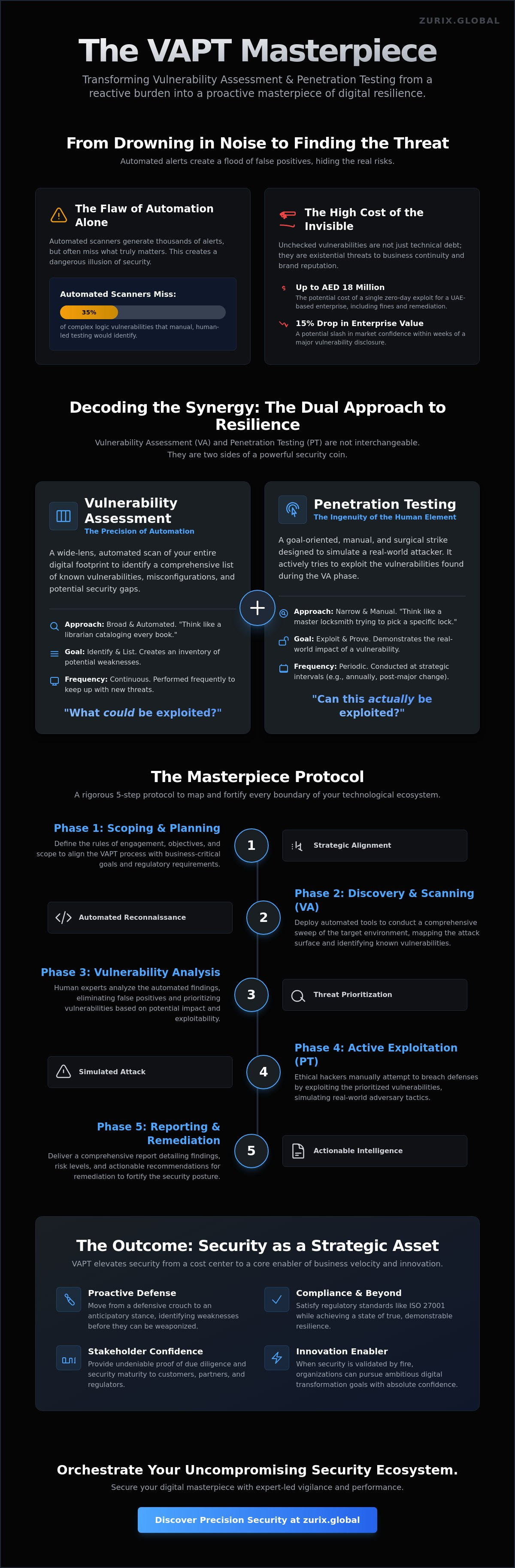
A single zero-day exploit can cost a UAE-based enterprise upwards of AED 18 million in remediation, regulatory fines, and lost market confidence. These aren't just technical errors; they're existential threats to brand reputation. Hidden misconfigurations in cloud architecture often serve as silent entry points for sophisticated adversaries. VAPT is the ultimate validation of an organization's security posture.
- Zero-day vulnerabilities can slash enterprise value by 15% within weeks of public disclosure.
- Automated scanners miss 35% of complex logic vulnerabilities that a manual tester would identify.
- UAE organizations face unique regional threats that require localized, high-intensity testing protocols.
VAPT as a Strategic Asset
We view security as a masterpiece of engineering, not a burdensome cost center. By identifying weaknesses before they're weaponized, vulnerability assessment and penetration testing ensures uninterrupted business continuity in a market that never sleeps. It provides a psychological edge. Knowing your systems have survived simulated combat allows for bolder innovation and faster digital transformation. This rigorous testing is the practical application of Zero Trust principles; it ensures every access point is verified through actual performance rather than assumed safety.
The transition from a defensive crouch to a proactive stance is what separates market leaders from their competitors. It's about building a foundation so strong that security becomes an enabler of speed, not a bottleneck. When the architecture is validated by fire, the organization can scale with absolute confidence.
Decoding the Synergy: Vulnerability Assessment vs. Penetration Testing
True security isn't a static wall; it's a living, breathing ecosystem of resilience. In the UAE, where the digital economy is projected to contribute 20% to the non-oil GDP by 2031, the stakes for infrastructure integrity have never been higher. Understanding the nuanced difference between a vulnerability assessment and penetration testing is the first step toward achieving engineering excellence in defense. While they're often used interchangeably, they represent two distinct philosophies of protection that, when fused, create a masterpiece of security.
Vulnerability Assessment: The Precision of Automation
Vulnerability Assessment (VA) serves as the foundation of visibility. It's a wide-lens approach that uses high-tech automated tools to scan your entire network for known gaps. These tools cross-reference your systems against massive databases of Common Vulnerabilities and Exposures (CVEs), assigning a CVSS score to each finding. In the dynamic, containerized environments common in Dubai's fintech sector, continuous scanning is vital. It's not enough to scan once a year. You need a persistent pulse on your assets. However, automation produces noise. Expert calibration is required to filter out false positives that can distract your IT team. We view VA as the blueprint phase, identifying every possible point of entry before the first brick of defense is laid.
Penetration Testing: The Art of the Hunt
If VA is the blueprint, Penetration Testing (PT) is the stress test of the actual structure. This is a surgical strike. It moves beyond identifying a gap to actually exploiting it. By simulating the attacker's mindset, a controlled attack simulation reveals the true impact of a breach. Whether it's a black-box test with zero prior knowledge or a white-box audit with full transparency, the goal is to find creative paths to sensitive data. Manual exploitation is the soul of this process. It uncovers complex logic flaws and "daisychaining" opportunities that automated tools simply cannot see. It's the difference between knowing a door is unlocked and knowing exactly what an intruder can steal once they're inside.
The most robust organizations in the Emirates don't choose one over the other. They recognize that a comprehensive vulnerability assessment and penetration testing strategy provides 360-degree visibility. Automation provides the scale, while human expertise provides the depth. This synergy ensures that no stone is left unturned and no logic flaw remains hidden. At Zurix, we treat these disciplines as the dual pillars of a digital masterpiece, ensuring your infrastructure isn't just compliant with NESA or DESC standards, but truly impenetrable. Security isn't a checkbox; it's an uncompromising commitment to performance and precision.
The Architect’s Dilemma: Frequency, Scope, and Strategic Selection
Designing a resilient digital fortress requires more than just installing the latest hardware; it demands a continuous cycle of evaluation and refinement. The architect faces a critical choice: how often to test and where to point the lens. While many organizations in the UAE settle for an annual check to satisfy auditors, true security leaders adopt a risk-driven schedule. This means triggering vulnerability assessment and penetration testing after every major architectural change, such as migrating workloads to a new cloud region or deploying a fresh API gateway. It's a commitment to perfection where the frequency matches the pace of innovation.
Prioritizing targets is an exercise in business logic. You must identify which assets hold the "crown jewels," such as customer databases or proprietary financial algorithms, and subject them to the most rigorous scrutiny. A common fear among stakeholders is that active testing might disrupt live operations. This concern is valid but often misplaced. Professional testers treat production environments with surgical precision. They use rate-limiting and non-destructive payloads to ensure the masterpiece of your business operations remains functional while its defenses are being stressed. It's the difference between a controlled stress test and a chaotic failure.
Compliance as a Catalyst
In the United Arab Emirates, regulatory frameworks like the NESA IAS and the Dubai Electronic Security Center (DESC) standards have turned VAPT from an option into a necessity. Achieving ISO 27001 compliance requires documented evidence of technical risk management. Detailed VAPT reports serve as this evidence, proving to stakeholders that your security posture isn't just a claim, but a verified reality. Organizations following the PCI SSC Penetration Testing Guidance find that these assessments are vital for protecting the integrity of transaction environments. These reports provide the hűvösen precíz (coolly precise) data needed to satisfy both local regulators and international partners.
Tailoring Scope to Modern Infrastructure
The traditional perimeter has dissolved, replaced by a complex web of microservices and hybrid clouds. Modern vulnerability assessment and penetration testing must evolve to cover Kubernetes clusters, serverless functions, and the intricate mesh of APIs that power today's applications. A critical component of this scope is the evaluation of Identity and Access Management. Testers simulate credential theft to see if an attacker can move laterally from a low-level employee account to a high-privilege administrative role. With 65 percent of UAE employees working in hybrid models, testing remote access points and VPN endpoints isn't just a task; it's a mission-critical requirement to prevent unauthorized entry into your digital ecosystem.
The Masterpiece Protocol: A 5-Step Guide to Executing VAPT
Executing a vulnerability assessment and penetration testing engagement requires the same level of precision as a master engineer assembling a high-performance workstation. It's a structured journey that transforms raw data into a fortified digital fortress. Every step is deliberate. Every action serves a higher purpose of security excellence. We don't just find flaws; we engineer resilience.
- Phase 1: Planning and Scoping. We define the engagement's boundaries to ensure every critical asset is covered. In the UAE, 82% of enterprises now align their scope with NESA or Dubai ISR standards to maintain regulatory compliance and operational integrity.
- Phase 2: Information Gathering and Reconnaissance. Our experts map your digital footprint. We use advanced techniques to see what an attacker sees before they ever strike, identifying exposed entry points across your entire infrastructure.
- Phase 3: Vulnerability Analysis. This is the search for imperfections. We identify the weak points in your armor using both automated intelligence and human intuition to separate noise from genuine threats.
- Phase 4: Exploitation. We safely demonstrate real-world impact. This phase proves that a vulnerability isn't just a theory; it's a gateway that needs closing to protect your most valuable assets.
- Phase 5: Reporting and Remediation. We provide a visionary roadmap. This isn't just a list of flaws, it's a strategic guide to achieving a state of total, uncompromising security.
From Reconnaissance to Exploitation
Our team utilizes Open Source Intelligence (OSINT) and active scanning to build a comprehensive target profile that leaves no stone unturned. We respect the ethical boundaries of exploitation to ensure 100% system uptime and operational safety throughout the process. Translating a detected weakness into a tangible business risk requires moving beyond the scan to perform a controlled breach that mirrors the intent of a sophisticated adversary. This transition is critical for understanding how a single flaw could lead to a massive data leak in the competitive Dubai financial sector. We operate within the strict mandates of UAE Federal Decree-Law No. 34 of 2021 to ensure every test is legally sound and professionally executed.
Remediation: The Path to Perfection
True security isn't found in a long list of patches. We prioritize fixes based on actual exploitability rather than theoretical severity scores. This approach saved one UAE-based logistics firm over 120 hours of unnecessary manual patching in 2023. The re-test phase remains the most vital component of our protocol. It validates that every vulnerability is closed for good. By integrating these findings into automated DevOps pipelines, we help you achieve continuous improvement. Security becomes an inherent part of your DNA, not an afterthought. We don't settle for "good enough" when your reputation is on the line.
Zurix Global: Orchestrating Uncompromising Security Ecosystems
At Zurix Global, we don't view cybersecurity as a routine administrative task. We treat it as a high-stakes fusion of rigorous engineering and defensive art. Every line of code, every network node, and every cloud instance represents a canvas where we apply our craft. Our team provides 24/7 vigilance, ensuring that your digital assets remain untouched by those who seek to disrupt your vision. We conduct expert-led vulnerability assessment and penetration testing not as a simple checklist, but as a continuous pursuit of technical perfection.
We integrate these assessments into a holistic Managed Security Service (MSS) designed for total peace of mind. This isn't a fragmented approach. It's a unified strategy where every test informs a broader defensive posture. Our UAE-based experts bring a deep understanding of local market dynamics, from the high-growth sectors in Dubai to the critical infrastructure in Abu Dhabi, while maintaining global delivery capabilities that protect your interests anywhere on the map.
Beyond Testing: A Partnership in Resilience
Resilience isn't bought; it's built. We help UAE organizations architect "secure by design" IT ecosystems from the ground up. By leveraging our deep GRC (Governance, Risk, and Compliance) expertise, we align your vulnerability assessment and penetration testing results with global certifications and local mandates. Whether you're adhering to NESA requirements or the Dubai Information Security Regulation (ISR), we provide the precision needed for compliance. We empower your internal team with the technical insights required to maintain a superior security posture 365 days a year. Our mission is to transform your defense from a reactive cost center into a resilient masterpiece of engineering.
Secure Your Vision Today
Security shouldn't be a hurdle that slows down your innovation. It's a competitive edge in the fast-paced UAE market. You need a partner that understands the intersection of high-end technology and business strategy. We deliver the hallowed ground of compromise-free performance. Don't settle for "good enough" when perfection is the only acceptable outcome for your brand. It's time to consult with the experts at Zurix Global and transform your digital defense into a masterpiece of proactive protection. Your vision deserves the highest level of security orchestration available.
Elevating Your Defense to a Masterpiece of Security
Digital resilience in the UAE isn't a static achievement; it's a continuous pursuit of engineering perfection. By integrating a rigorous vulnerability assessment and penetration testing protocol, organizations transform their security from a reactive burden into a proactive shield. This synergy identifies hidden weaknesses and validates defense mechanisms against real-world attack vectors. The IBM Cost of a Data Breach Report 2023 indicates that organizations in the Middle East face average breach costs of AED 29.6 million, making precision-engineered security a financial imperative. We don't just scan for flaws; we architect resilience.
Zurix Global delivers this level of excellence through expert-led SOC operations and specialized knowledge in Cloud and Zero Trust Architecture. We combine a global perspective with local UAE precision to ensure your infrastructure remains impenetrable. It's about uncompromising performance. Every line of code and every network node deserves the scrutiny of a master. Don't settle for standard compliance when you can achieve a state of technological art. Your vision deserves a foundation that cannot be shaken. Trust the process of elite engineering.
Secure your digital masterpiece with Zurix Global's expert VAPT services.
Frequently Asked Questions
What is the primary difference between a vulnerability assessment and a penetration test?
Vulnerability assessment identifies your security flaws through systematic scanning, while penetration testing simulates a real-world attack to exploit those weaknesses. Think of an assessment as a comprehensive blueprint of every unlocked window in a Dubai villa, whereas a penetration test is the skilled intruder actually entering the building to see what assets they can reach. The Dubai Electronic Security Center mandates these distinctions for critical infrastructure providers to ensure a multi-layered defense strategy.
How often should my organization conduct VAPT to remain secure?
Your organization should conduct vulnerability assessment and penetration testing at least once every 12 months or immediately following major network reconfigurations. Statistics from the UAE Cyber Security Council indicate that 45% of breaches involve exploited vulnerabilities that remained unpatched for over 180 days. High-risk sectors like finance in the DIFC often require quarterly assessments to maintain their defensive posture against rapidly evolving threats in the Middle East.
Is penetration testing dangerous for my live business applications?
Professional penetration testing isn't dangerous for live business applications when executed by elite engineers who follow a strictly controlled methodology. We utilize surgical precision to ensure zero downtime, often scheduling high-intensity scans during low-traffic hours in Gulf Standard Time. Our experts coordinate every exploit attempt with your internal teams to maintain 100% service availability throughout the engagement. It's a controlled exercise in resilience, not a destructive one.
How long does a typical VAPT engagement take to complete?
A typical VAPT engagement takes between 10 and 20 business days to complete, depending on the complexity of your digital architecture. The initial scanning phase usually occupies the first 3 days, followed by 7 to 10 days of manual exploitation and deep-dive analysis. We conclude the process with a 3-day reporting phase that transforms raw data into a strategic roadmap for your technical leadership. Precision takes time, and we don't rush the pursuit of perfection.
What kind of report should I expect at the end of a VAPT process?
You'll receive a dual-layered technical masterpiece that bridges the gap between executive vision and engineering reality. The report includes a high-level summary for stakeholders and a granular technical breakdown for your IT team, detailing every vulnerability found with its specific CVSS score. Each finding comes with a concrete remediation plan. This ensures your defense evolves from a fragile state to a position of absolute, uncompromising resilience.
Can VAPT help my organization achieve ISO 27001 or SOC2 compliance?
VAPT is a critical pillar for achieving ISO 27001 and SOC2 compliance, as these frameworks require evidence of regular security monitoring and risk management. Clause A.12.6.1 of ISO 27001 specifically demands the management of technical vulnerabilities to prevent exploitation. By conducting these tests, UAE businesses demonstrate the due diligence required by regulators like the Central Bank of the UAE to protect sensitive financial data and maintain operational integrity.
What is the difference between automated and manual penetration testing?
Automated testing uses software to quickly identify common vulnerabilities, while manual testing involves a human expert who uses intuition to uncover complex logic flaws. Automated tools can't replicate the creative persistence of a determined adversary. We combine both approaches to ensure your vulnerability assessment and penetration testing covers every conceivable angle. This hybrid model leaves no stone unturned in your digital fortress, providing a level of security that machines alone can't achieve.
How do I determine the right scope for my first VAPT engagement?
Determine your scope by identifying the 2 or 3 most critical assets that would cause a total business collapse if compromised. Focus your first engagement on public-facing IPs, primary web applications, and internal databases containing sensitive customer information. A well-defined scope ensures resources are concentrated where they matter most. You don't want to dilute your efforts across low-risk legacy systems that don't impact your core operations or your reputation in the UAE market.